
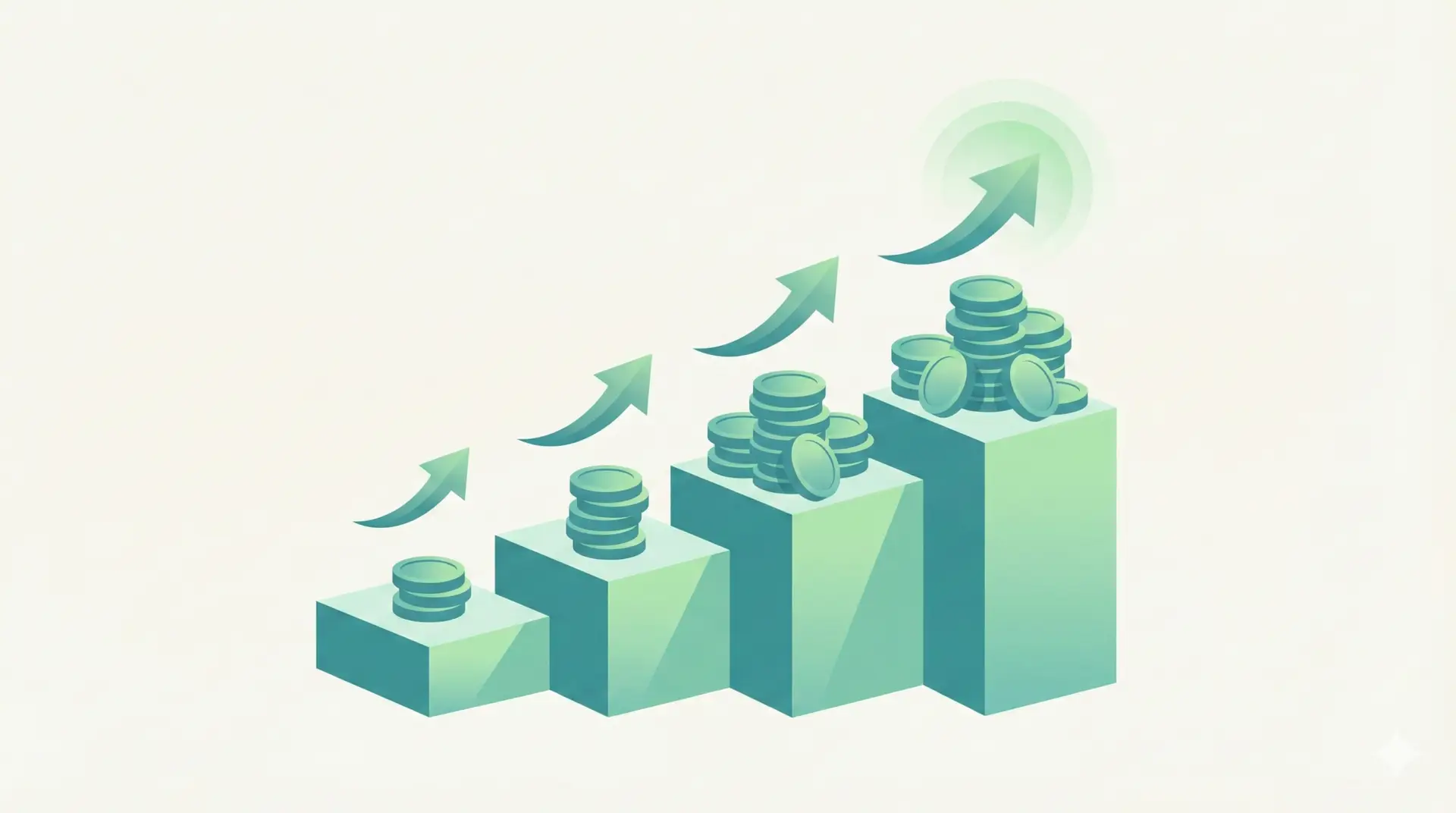

Interest is the price of money over time—the cost of borrowing it or the reward for lending it. Despite its fundamental role in personal finance, mortgages, credit cards, savings accounts, and investments, interest remains mystifying to many people navigating financial decisions. Understanding how interest truly works transforms abstract percentages into concrete dollars, empowering you to make choices that save thousands or earn thousands over your lifetime. Whether you’re paying interest on debt or earning it on savings, grasping these mechanics is essential to financial literacy and long-term wealth building.
- Simple Interest: The Foundation of All Interest Calculations
- Compound Interest: The Most Powerful Force in Finance
- Real-World Example: Credit Card Interest in Action
- Savings Account Interest: Making Your Money Work for You
- Mortgage Interest: Understanding Your Largest Debt
- Investment Returns: Compound Interest on Steroids
Simple Interest: The Foundation of All Interest Calculations
Simple interest represents the most straightforward calculation: interest charged only on the original principal amount. The formula is Principal × Rate × Time. If you borrow $1,000 at 5% simple annual interest for three years, you calculate $1,000 × 0.05 × 3 = $150 in total interest. Your repayment would be $1,150—the original $1,000 plus $150 in interest charges.
Simple interest appears in certain short-term loans, some bonds, and basic savings scenarios. While uncommon in consumer banking today, understanding simple interest provides the foundation for grasping more complex calculations. The key characteristic is that interest never compounds—it’s always calculated on the same principal amount regardless of how much time passes or how much interest has already accumulated on the loan or investment.
Compound Interest: The Most Powerful Force in Finance
Compound interest calculates interest on both the original principal and all previously accumulated interest. This creates exponential growth that accelerates over time. With the same $1,000 at 5% annual interest compounded annually for three years, the calculation differs dramatically. Year one: $1,000 × 1.05 = $1,050. Year two: $1,050 × 1.05 = $1,102.50. Year three: $1,102.50 × 1.05 = $1,157.63.
Compound interest is the eighth wonder of the world. He who understands it, earns it; he who doesn’t, pays it. The most powerful force in the universe is compound interest.Albert Einstein, Theoretical Physicist
Notice the difference: simple interest produced $150 total, while compound interest generated $157.63—an extra $7.63 from interest earning interest. This gap widens dramatically over longer periods. Compound interest explains why starting retirement savings early matters so much and why high-interest credit card debt becomes so difficult to escape. The compounding frequency—daily, monthly, quarterly, or annually—significantly impacts results, with more frequent compounding accelerating growth or debt accumulation.
Real-World Example: Credit Card Interest in Action
Credit cards typically advertise Annual Percentage Rates (APR) but calculate interest daily using compound interest. Consider a $5,000 credit card balance at 18% APR with minimum payments of 2% of the balance. The daily rate is 18% ÷ 365 = 0.0493% per day. After one month (30 days), interest compounds daily, adding approximately $74 to your balance.
- Month 1: $5,000 balance generates $74 interest; minimum payment of $100 leaves $4,974 balance
- Month 2: $4,974 balance generates $73 interest; minimum payment of $99 leaves $4,948 balance
- Paying only minimums would take 31 years and cost $8,615 in interest on the original $5,000 debt
- Paying $200 monthly instead reduces payoff time to 2.5 years with only $1,126 in total interest
- The difference between minimum and aggressive payments saves $7,489 and 28.5 years of debt
- Each dollar of principal paid early saves compound interest across all future months
Savings Account Interest: Making Your Money Work for You
Interest works in your favor when you’re the lender, such as depositing money in savings accounts or certificates of deposit. A high-yield savings account offering 4.5% APY (Annual Percentage Yield) compounded daily transforms idle cash into growing wealth. Starting with $10,000 and adding $200 monthly, compound interest accelerates accumulation dramatically over time.
After one year, you’ve contributed $12,400, but your balance reaches approximately $12,679—earning $279 in interest. After five years with consistent deposits, you’ve contributed $22,000, but compound interest grows your balance to approximately $24,563, earning $2,563 in free money. After twenty years, your $58,000 in contributions becomes $115,729 through the power of compound interest earning on previous interest, generating $57,729 without any additional work or risk beyond selecting the right savings vehicle.

Mortgage Interest: Understanding Your Largest Debt
Mortgages use compound interest with amortization—a repayment structure where early payments consist mostly of interest while later payments pay down principal. Consider a $300,000 mortgage at 6.5% interest over 30 years. Your monthly payment would be approximately $1,896. In month one, roughly $1,625 goes to interest and only $271 to principal. By year fifteen, the ratio shifts to approximately $1,100 interest and $796 principal per payment.
Over the full 30-year term, you’ll pay approximately $382,633 in total interest—more than the original loan amount. However, making extra principal payments dramatically reduces this burden. An additional $200 monthly payment reduces the loan term by nearly seven years and saves approximately $81,000 in interest. Even one extra mortgage payment per year, applied to principal, can save tens of thousands over the loan’s lifetime by reducing the principal that generates future compound interest charges.
Interest Rate Shopping Power
Small percentage differences create enormous dollar differences over time due to compound interest. On a $300,000 mortgage, the difference between 6.5% and 6.0% interest rates saves approximately $35,000 over 30 years. Always compare rates from multiple lenders, improve your credit score before applying for major loans, and negotiate aggressively. For savings and investments, seek the highest rates available—a 4.5% savings account earns 50% more than a 3.0% account on the same balance over time.
Investment Returns: Compound Interest on Steroids
Investment accounts harness compound interest most powerfully because returns typically exceed savings account rates. Historical stock market returns average approximately 10% annually, though with significant year-to-year volatility. Investing $500 monthly starting at age 25 with 10% average annual returns compounds to approximately $2.84 million by age 65—$240,000 in contributions generating $2.6 million in compound growth.
Starting the same investment at age 35 instead yields approximately $1.03 million—less than half the result despite only ten fewer years of contributions. Those first ten years generated over $1.8 million of the difference through compound growth. This demonstrates why financial advisors emphasize starting retirement savings early. Time in the market beats timing the market because compound interest requires time to work its exponential magic. Each year of delay costs exponentially more in future wealth than the amount you would have contributed.
Interest is neither inherently good nor bad—it’s a tool that works for or against you depending on which side of the transaction you occupy. When borrowing, interest compounds to increase debt; when saving or investing, it compounds to build wealth. Understanding these mechanics transforms interest from mysterious percentages into predictable mathematical forces you can leverage strategically. Calculate before you borrow, compound intentionally when you save, and never underestimate the long-term impact of seemingly small interest rate differences. Master interest, and you master a fundamental lever of financial success.