
If you have ever wondered exactly how stocks are selected for Nifty 50 index, the answer is not a matter of opinion or a committee picking favorites. The National Stock Exchange uses a strict, rules-based methodology tied to liquidity, free float market capitalization, and sector neutrality. Here is a plain-English walkthrough of the actual thresholds, review timelines, and rebalancing mechanics that determine which companies enter and exit India's most tracked benchmark.
What Is the Nifty 50 Index and Who Maintains It
Nifty 50 is the flagship large-cap benchmark of the National Stock Exchange of India (NSE). It tracks the weighted performance of 50 of the largest and most liquid listed companies across key sectors of the Indian economy. The index was launched on April 22, 1996, with a base date of November 3, 1995, and a base value of 1,000.
The index is owned and managed by NSE Indices Limited, a subsidiary of NSE. A specialized committee called the Index Maintenance Sub-Committee (IMSC) is responsible for governing the index, reviewing its composition, and approving any corporate action adjustments. NSE Indices publishes the rules in advance so fund managers, brokers, and retail investors can anticipate changes rather than react to opaque decisions.
Nifty 50 is widely used as a performance benchmark for Indian equity mutual funds and as the underlying index for exchange-traded funds (ETFs), index derivatives, and algorithmic trading strategies. Its real-time computation makes it the most referenced gauge of Indian market sentiment, both domestically and by foreign institutional investors.
The Starting Universe: Why Nifty 500 Comes First
Before a stock can be considered for Nifty 50, it must belong to a broader parent universe: the Nifty 500 index. The logic is straightforward. Nifty 500 captures approximately 95 percent of the total market capitalization of all listed companies on the NSE. It includes large-cap, mid-cap, and small-cap segments, making it the ideal pool from which to filter the top 50 large-cap names.
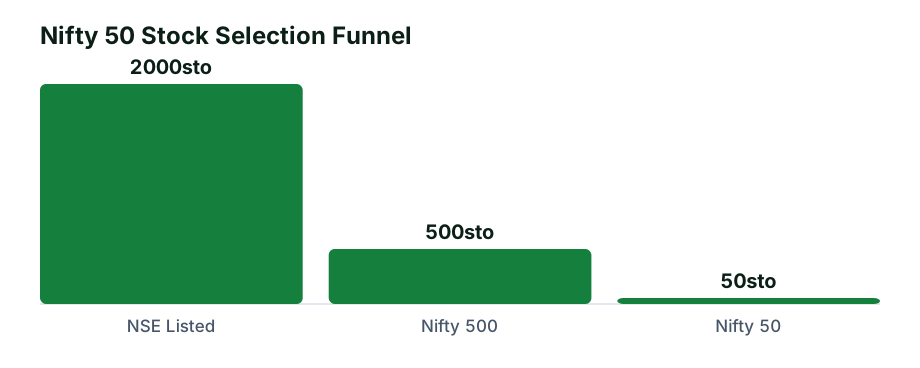
NSE applies a top-down funnel approach. If a company is not part of Nifty 500, it cannot enter Nifty 50, regardless of its individual market cap or recent price performance. This ensures the final index constituents are drawn from companies that already meet baseline listing, trading, and settlement standards.
The funnel works as follows:
- All NSE-listed companies are screened for basic listing tenure and trading eligibility.
- Eligible companies are ranked to form the Nifty 500 universe.
- From within Nifty 500, the top 150 companies by full market capitalization are identified as the eligible large-cap pool.
- The final Nifty 50 list is drawn from this large-cap pool using free float market cap and liquidity filters.
This multi-layered structure prevents a newly listed company with a massive valuation but limited trading history from jumping directly into Nifty 50 and distorting the benchmark.
Nifty 50 Eligibility Criteria for Stock Inclusion
The Nifty 50 eligibility criteria are quantitative. There is no discretionary selection by the index committee beyond enforcing the published rules. A stock must clear every threshold to be considered for inclusion during a review.
The core eligibility requirements are:
- Universe inclusion: The stock must be a constituent of the Nifty 500 index at the time of the review.
- Listing tenure: The stock must have a minimum listing history of at least one month on the NSE. For index methodological purposes, a full calendar month of trading is generally required before eligibility kicks in.
- Domicile: The company must be an Indian company listed on the NSE with equity shares traded in the standard rolling settlement cycle. Foreign companies, including those with Indian depository receipts, are not eligible.
- Trading frequency: The stock must have traded on at least 90 percent of trading days during the last six months for inclusion consideration.
- Turnover impact cost: The stock must rank among the top 150 companies by full market capitalization, and its impact cost must be within acceptable bounds. Impact cost is the price impact of executing a specific order size, and it serves as a proxy for liquidity.
- Sector representation: NSE aims for the index to reflect the broader equity market. While there is no rigid sector quota, the methodology discourages excessive concentration in any single sector.
For exclusion purposes, a slightly relaxed liquidity rule applies. A stock already in the index is considered for removal if it ranks beyond 75th position by full market capitalization, or if its trading frequency falls below 80 percent of the total trading days during the review period. This buffer prevents excessive churn caused by short-term price volatility.
| Eligibility Parameter | Requirement for Inclusion | Threshold Triggering Exclusion Review |
|---|---|---|
| Index Universe | Must be in Nifty 500 | Dropped from Nifty 500 |
| Listing History | Minimum 1 month on NSE | N/A (already listed) |
| Trading Frequency | Traded on 90 percent of days in 6 months | Traded on fewer than 80 percent of days |
| Market Cap Rank | Within top 150 by full market cap | Rank falls below 75th position |
| Impact Cost | Among the most liquid in the large-cap pool | Consistently high impact cost relative to peers |
How Free Float Market Capitalization Determines Selection
Once the eligibility filters are cleared, the actual ranking of stocks is based on free float market capitalization, not full market capitalization. This is a critical distinction that directly affects which companies make the final cut.
Full market capitalization is calculated as the total number of outstanding shares multiplied by the current market price. Free float market capitalization, however, considers only the shares available for public trading. It excludes promoter holdings, government stakes, strategic holdings by locked-in entities, and other shares not available for trading in the open market.
The formula for free float market cap is:
Free Float Market Cap = Total Shares Outstanding × Free Float Factor × Market Price
The free float factor is a percentage determined by NSE based on the proportion of shares held by non-promoters. NSE categorizes companies into free float bands, such as 0.25, 0.50, 0.75, or 1.00, depending on the exact shareholding pattern disclosed to the exchanges.
This methodology means a company with a massive total market cap but a very high promoter holding might rank lower than a company with a smaller total market cap but a much larger public float. For example, a public sector bank with a 70 percent government stake will have a lower free float market cap than a private sector peer of similar size where 80 percent of shares are with institutions and the public.
The 50 companies with the highest free float market capitalization within the eligible large-cap pool are selected for the index. Weights within the index are then assigned based on free float market cap, with each stock's weight capped at 5 percent at the time of rebalancing to prevent excessive single-stock concentration. This cap is a more recent methodology enhancement aimed at reducing concentration risk in passive funds that track the index.
Nifty 50 Reconstitution Frequency and Timeline
One of the most common questions from retail investors concerns Nifty 50 rebalancing frequency. NSE reviews Nifty 50 every six months. The reviews are data-driven and follow a predictable calendar, giving market participants time to adjust their portfolios.
The standard review schedule is:
- First review of the year: Data cutoff is January 31. Changes are announced by late February and implemented on the last trading day of March.
- Second review of the year: Data cutoff is July 31. Changes are announced by late August and implemented on the last trading day of September.
The six-month data period used for the review ends one month prior to the cutoff date. For instance, the March 2026 reconstitution uses liquidity and market cap data from the period ending December 31, 2025. This lag gives the index committee time to compute averages, verify trading days, and finalize rankings.
During each review, the Index Maintenance Sub-Committee evaluates all 50 existing constituents against the eligibility criteria and compares them with the next set of eligible candidates from the large-cap pool. If an existing constituent fails the exclusion threshold and a new candidate ranks higher, the replacement is made. If no eligible candidate is available, the committee may retain the existing stock until the next review.
Corporate actions such as mergers, demergers, suspensions, or compulsory delistings can trigger an intra-period replacement outside the standard March and September cycle. In such cases, the next highest-ranked eligible company from the most recent review is brought in as a replacement.
What Triggers a Stock's Removal from Nifty 50
A stock does not need to collapse in price to be removed from the index. The Nifty 50 inclusion and exclusion process is primarily driven by relative ranking and trading metrics, not absolute stock performance.
The most common triggers for exclusion are:
- Ranking decline: If an existing constituent's full market capitalization rank falls below 75th position during the review period, it becomes a candidate for removal. The buffer between the 50th position for inclusion and 75th for exclusion is designed to limit unnecessary turnover.
- Liquidity deterioration: If a stock's trading frequency falls below the required 80 percent threshold, or if its impact cost worsens significantly, it can be removed even if its market cap rank is acceptable.
- Corporate action: Mergers, acquisitions, or delisting events can force an immediate replacement.
- Universe exit: If a stock is dropped from the underlying Nifty 500 index, it automatically loses eligibility for Nifty 50.
- Insolvency or suspension: If a company is admitted to the insolvency resolution process under the IBC or its shares are suspended from trading, it is removed from the index.
When a stock is removed, the next highest-ranked eligible stock from the large-cap pool is added. The replacement is announced four weeks before the effective date, allowing passive funds to execute their trades in a phased manner and reducing price disruption around the change. Sudden index moves can occasionally coincide with broader market volatility, which is why understanding NSE market circuit breakers helps contextualize large single-day moves during reconstitution periods.
How Index Changes Affect ETFs and Index Funds
The Nifty 50 index reconstitution rules have a direct mechanical impact on passive funds. When a stock enters or exits the index, every ETF and index fund tracking Nifty 50 must buy or sell that stock to mirror the updated composition. This creates predictable, large-block trading activity on the effective date of the change.
For retail investors holding Nifty 50 ETFs or index funds, the rebalancing happens automatically within the fund. There is no tax incidence for the investor during this internal adjustment. The fund manager handles the buying and selling, and the expense ratio covers the transaction costs.
However, active mutual fund managers and institutional desks watch these changes closely. A stock being added to Nifty 50 often sees pre-emptive buying by arbitrage funds and passive fund managers in the days leading up to the effective date. Similarly, a stock being removed can face selling pressure. This phenomenon is sometimes called the index effect, and it can create short-term price distortions that active traders monitor.
The table below summarizes the typical sequence of events during a reconstitution:
| Stage | Timeline | Action |
|---|---|---|
| Data Cutoff | January 31 / July 31 | Six-month performance and liquidity data finalized |
| Announcement | Late February / Late August | NSE publishes the list of additions and deletions |
| Transition Window | 4 weeks before effective date | Passive funds prepare to rebalance; active desks position |
| Effective Date | Last trading day of March / September | New index composition goes live; ETFs execute trades |
Where to Find Official Nifty 50 Methodology Documents
For investors who want to verify the exact thresholds or review historical changes, NSE Indices publishes the full methodology document on its website. The document covers index construction, eligibility criteria, corporate action adjustments, and reconstitution rules in detail.
You can access the methodology document at the NSE Indices website under the "Indices" section, specifically within the "Methodology" tab for Nifty 50. Historical additions and deletions, along with effective dates, are also available in the "Announcements" archive. Cross-referencing these documents helps investors understand why a specific stock was added or removed at a particular review.
For ongoing updates on index changes, market structure, and broader investing fundamentals, you can follow more markets explainers on FinanceCity. Staying updated with these explainers helps you anticipate how index shifts might affect your portfolio, especially if you hold sector-specific funds or individual large-cap stocks.
Frequently asked questions
How often is Nifty 50 reconstituted?
Nifty 50 is reviewed every six months, with changes typically implemented in March and September.
What is the base year and base value of Nifty 50?
Nifty 50 uses November 3, 1995 as the base date with a base value of 1,000.
What happens to index funds when Nifty 50 composition changes?
Index funds and ETFs tracking Nifty 50 automatically rebalance their portfolios to match the updated index during each reconstitution.
Can a stock be removed from Nifty 50 for low liquidity?
Yes, stocks that fail to meet the minimum liquidity and trading frequency requirements during the review period can be excluded from Nifty 50.