
Earnings Per Share (EPS) is one of the most quoted metrics in stock analysis, yet many Indian retail investors misunderstand what it actually measures and how to use it. In this guide, we'll show you exactly how to read and interpret EPS for NSE and BSE listed companies, why it matters for your investment decisions, and how to avoid the common pitfalls that lead to poor stock picks.
What Is Earnings Per Share (EPS)?
Earnings Per Share is the portion of a company's profit allocated to each outstanding share of stock. It's a simple idea: if a company makes ₹100 crore in profit and has 10 crore shares outstanding, each share gets a claim on ₹10 of profit. That's the EPS.
EPS is expressed in rupees per share. For example, if Reliance Industries reports an EPS of ₹65 for a financial year, it means each share of Reliance is backed by ₹65 of annual profit.
The metric serves as a bridge between a company's total profitability and what matters to individual shareholders: how much profit "belongs" to them per share held. It's one of the inputs in calculating the Price-to-Earnings (P/E) ratio, which tells you how expensive a stock is relative to its earnings.
How Is EPS Calculated for Indian Stocks?
The EPS formula is straightforward:
EPS = Net Profit ÷ Number of Outstanding Shares
Let's work through a concrete example. Suppose Infosys reports:
- Net Profit (PAT): ₹24,000 crore
- Weighted Average Shares Outstanding: 240 crore
EPS = ₹24,000 crore ÷ 240 crore shares = ₹100 per share
Key points on the calculation:
- Net Profit used: This is the profit after all expenses, interest, tax, and minority interests. For Indian companies, you'll find this as "Profit After Tax" (PAT) or "Net Profit" in the P&L statement.
- Weighted average shares: Companies use the average number of shares outstanding during the period, not just the year-end count. This accounts for share buybacks or new issuances during the year.
- Reporting frequency: Indian listed companies report EPS quarterly (every three months) and annually (for the full financial year). The annual figure for FY 2026-27 will be announced in May or June 2027.
You can find EPS figures in a company's financial statements, on the NSE/BSE websites, or on financial data platforms like Moneycontrol or TradingView. Always verify the EPS period—whether it's quarterly, trailing twelve months (TTM), or full year.
Why EPS Matters: What It Tells You About a Company
EPS is a window into profitability per share. A rising EPS over time suggests the company is generating more profit from its operations, becoming more efficient, or growing its earnings base. A falling EPS can signal operational trouble or dilution from new share issuances.
However, EPS alone doesn't tell the whole story. A company could boost EPS by:
- Buying back shares (reducing the denominator without increasing profit)
- Taking on debt to fund growth
- Cutting costs unsustainably
- Benefiting from one-time gains
This is why EPS must be paired with other metrics. Look at Return on Equity (ROE) to see how efficiently the company is using shareholder capital. Check the debt-to-equity ratio to ensure growth isn't built on excessive leverage. Review profitability and solvency metrics to confirm the company can sustain its earnings.
Good vs. Poor EPS: Context and Sector Benchmarks
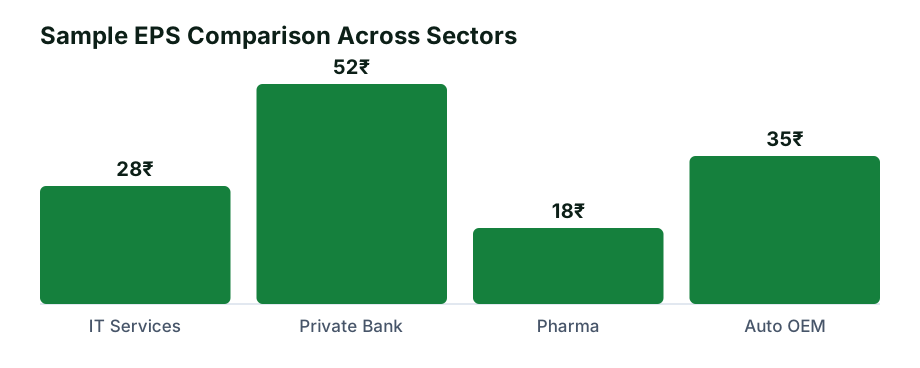
There is no universal "good" EPS number. A ₹50 EPS for a bank is not directly comparable to a ₹15 EPS for a software company. Sector, company size, and growth stage all matter.
Sector benchmarks (approximate, as of 2026):
| Sector | Typical EPS Range | Notes |
|---|---|---|
| IT & Software | ₹20–₹80 | High margins, capital-light, mature companies have higher EPS |
| Banking | ₹40–₹120 | Depends on asset quality and profitability; large banks tend higher |
| Pharmaceuticals | ₹15–₹60 | Varies by company size and R&D intensity |
| FMCG | ₹10–₹40 | Stable, mature sector; EPS reflects brand strength |
| Automobiles | ₹30–₹100 | Cyclical; EPS fluctuates with demand and commodity prices |
| Metals & Mining | ₹20–₹150 | Highly cyclical; EPS swings with commodity cycles |
Better approach: Instead of asking "Is ₹25 good?", ask:
- How does this company's EPS compare to its peers in the same sector?
- Has the company's EPS grown over the last 3–5 years?
- Is EPS growth in line with revenue growth, or is it coming from cost-cutting alone?
For instance, if TCS reports EPS of ₹65 and Infosys reports ₹100, you can't say Infosys is "better" just from that. Compare their P/E ratios, ROE, and EPS growth rates. A smaller company in a high-growth phase may have lower absolute EPS but stronger EPS growth, making it potentially more attractive.
EPS vs. Net Profit: Why EPS Is More Useful for Investors
Net Profit is the total profit a company earns; EPS is that profit divided by shares. For investors, EPS is more useful because it adjusts for company size.
| Metric | Meaning | Useful For |
|---|---|---|
| Net Profit | Total profit (₹ crore) | Understanding company scale, comparing revenue to profit |
| EPS | Profit per share (₹) | Comparing valuations, assessing shareholder returns, P/E ratio |
Imagine two companies:
- Company A: Net Profit ₹500 crore, 50 crore shares → EPS ₹10
- Company B: Net Profit ₹1,000 crore, 200 crore shares → EPS ₹5
Company B has higher total profit, but Company A has higher EPS. For a shareholder, Company A's shares are backed by more profit per share. If both trade at a P/E of 15, Company A's stock price would be ₹150 and Company B's ₹75—reflecting the per-share earning power.
How to Use EPS in Your Stock Analysis
Step 1: Track EPS growth
Pull EPS data for the last 5 years (annual) or 8 quarters (quarterly). Plot it or calculate the CAGR (Compound Annual Growth Rate):
EPS CAGR = (Latest EPS ÷ EPS 5 years ago)^(1/5) − 1
A company with 15% annual EPS growth is generally more attractive than one with flat or declining EPS, all else equal.
Step 2: Compare to peers
Identify 3–5 competitors in the same sector. Compare their latest EPS, EPS growth rate, and P/E ratio. If Company X has higher EPS growth but a lower P/E, it may be undervalued relative to peers.
Step 3: Check the quality of earnings
Ensure EPS growth comes from operational improvement, not one-time gains or unsustainable cost cuts. Review the Management Discussion & Analysis (MD&A) section in the annual report. Look for:
- Revenue growth in line with EPS growth (healthy sign)
- Stable or improving operating margins
- Consistent cash flow from operations
Step 4: Pair with valuation and risk metrics
Use EPS to calculate the P/E ratio: P/E = Stock Price ÷ EPS. A low P/E might indicate undervaluation or hidden problems. A high P/E might reflect growth expectations or overvaluation. Always cross-check with ROE, debt-to-equity ratio, and cash flow metrics.
Step 5: Monitor for dilution
If the number of shares outstanding grows significantly without a matching increase in profit, EPS will decline even if total profit rises. This is a red flag. Check the company's share buyback or issuance activity in the cash flow statement.
Common EPS Mistakes Indian Retail Investors Make
Mistake 1: Comparing absolute EPS across sectors
Comparing a bank's ₹80 EPS to a software company's ₹40 EPS without context is meaningless. Always compare within sector peers.
Mistake 2: Ignoring the P/E ratio
A high EPS doesn't mean a cheap stock. If the stock price is proportionally high, the P/E will be high, and you may be overpaying. Always check both EPS and P/E together.
Mistake 3: Confusing EPS growth with stock price growth
A company with 20% EPS growth doesn't guarantee 20% stock price growth. The stock price depends on investor sentiment, market conditions, and whether the growth was already priced in. EPS is just one input.
Mistake 4: Using only the latest quarter
Quarterly EPS can be volatile due to seasonal factors, one-time items, or working capital changes. Always look at trailing twelve months (TTM) or full-year EPS for a clearer picture.
Mistake 5: Ignoring share dilution
A company might report rising EPS while diluting shareholders through new share issuances or employee stock options. Check the weighted average share count year-over-year. If shares grew 10% but EPS grew only 5%, real earnings per share actually fell.
Mistake 6: Assuming higher EPS = better investment
EPS is one metric. A company with ₹100 EPS but 20% debt-to-equity and declining ROE is riskier than one with ₹50 EPS, low debt, and rising ROE. Always build a complete fundamental picture.
EPS and Dividend Payout: The Connection
Companies pay dividends from their earnings. If a company reports EPS of ₹20 and pays a dividend of ₹8 per share, the dividend payout ratio is 40% (₹8 ÷ ₹20).
| Payout Ratio | What It Means | Typical for |
|---|---|---|
| Under 30% | Company retains most earnings for growth | High-growth companies, startups |
| 30–60% | Balanced approach; growth + shareholder returns | Mature, profitable companies |
| Over 60% | Prioritizes dividends; limited reinvestment | Mature, stable sectors (utilities, banks) |
A sustainable dividend payout ratio depends on the company's growth stage and sector. A 50% payout for a mature FMCG company is healthy. A 50% payout for a high-growth software company might be too high if it constrains R&D or expansion.
Watch out: If EPS is flat or falling but dividends are rising, the payout ratio is climbing, which is unsustainable. The company will eventually cut the dividend or face financial stress.
For Nifty 50 companies, dividend sustainability is a key consideration. Many large-cap companies balance growth reinvestment with shareholder payouts. Review the last 3 years of EPS and dividend data to confirm the payout is stable and sustainable.
Frequently asked questions
Q: What is a good EPS for an Indian stock?
There's no universal "good" EPS—it depends on the sector, company size, and growth stage. Compare a company's EPS to its peers in the same sector and track its EPS growth trend over 3–5 years rather than looking at absolute numbers alone. A 15% annual EPS growth rate is generally considered healthy for a mature company, while 25%+ is excellent for a growth-stage firm.
Q: Can I compare EPS across different companies?
Not directly. A bank with EPS of ₹50 and a software company with EPS of ₹30 cannot be compared without context. Always compare EPS within the same sector and adjust for company size using valuation ratios like P/E ratio. The P/E ratio normalizes for differences in absolute EPS and makes cross-company comparison meaningful.
Q: Why is rising EPS important?
Rising EPS over time signals that a company is becoming more profitable and efficient. Combined with stable or falling share count, it indicates genuine earnings growth rather than inflation or accounting tricks. If EPS grows but the share count also grows significantly, the real earnings per share may have grown less than the reported EPS suggests.
Q: How does EPS relate to dividend payments?
Companies pay dividends from their earnings. If EPS is ₹10 and a company pays ₹3 per share dividend, it retains ₹7 per share for growth. A sustainable dividend payout ratio is typically 30–60% of EPS. If a company pays out under 30%, it may be hoarding cash; if over 70%, the dividend is at risk if earnings decline.