
If you have ever wondered why HDFC Bank carries more weight in Nifty 50 than several PSU stocks with similar total market caps, the answer lies in free float. This article explains what is free float market capitalization in Nifty 50, how it differs from total market cap, and walks through a concrete calculation so you can see exactly how excluding promoter shares changes index weightage.
What Is Free Float Market Capitalization in Nifty 50
Free float market capitalization is the portion of a company's total market value that is actually available for trading in the open market. It strips out shares that are locked in and cannot be sold easily — promoter holdings, government stakes, strategic investor shares, and locked-in employee ESOPs.
The free float market cap meaning becomes clear when you think about who actually owns shares that can change hands on a given trading day. If a promoter family holds 70 percent of a company and has no intention of selling, those shares are not really part of the tradable supply. They sit on the balance sheet but never appear in the order book. Free float focuses only on the shares that do.
For Indian stocks, the free float shares meaning in Indian stocks specifically refers to the number of shares that are not classified under any of the excluded categories defined by NSE. A company can be massive on paper — say ₹10 lakh crore in total market cap — but if 80 percent of that is locked in with the promoter, only ₹2 lakh crore is genuinely floating in the market.
This matters because index movements are driven by actual trading, not by theoretical valuations of dormant shares. That is why NSE built Nifty 50 on free float and not on full market cap.
Total Market Cap vs Free Float Market Cap: The Key Difference
The difference between market cap and free float market cap comes down to one variable: which shares you count.
- Total market cap = Share price × Total number of outstanding shares
- Free float market cap = Share price × Number of freely tradable shares
Both use the same share price. The gap is in the share count.
| Parameter | Total Market Cap | Free Float Market Cap |
|---|---|---|
| Formula | Price × Total shares | Price × Free float shares |
| Includes promoter shares | Yes | No |
| Includes government stake | Yes | No |
| Includes locked-in ESOPs | Yes | No |
| Reflects tradable liquidity | No | Yes |
| Used by Nifty 50 | No | Yes |
A practical way to see the gap: consider a PSU where the Government of India holds 65 percent. The total market cap includes that 65 percent, even though it is effectively dormant. The free float market cap only counts the 35 percent that institutions, mutual funds and retail investors actually trade.
This is also why two companies with similar total market caps can have very different influence on the index. The one with the larger free float pulls Nifty more.
How NSE Calculates Free Float for Nifty 50 Stocks
NSE does not leave free float calculation to interpretation. It uses a defined methodology based on the Investible Weight Factor, or IWF. For every Nifty 50 constituent, NSE assigns an IWF between 0 and 1 that represents the proportion of shares considered investible.
The IWF is calculated by excluding the following categories from total shares:
- Promoter and promoter group holdings
- Government holdings in PSUs and PSU banks
- Strategic investor stakes locked in under regulatory agreements
- Shares under lock-in due to IPO, FPO or preferential allotment
- Employee ESOPs that are still in the lock-in period
- Shares held by associate or group companies that are not freely transferable
Once these are removed, the remaining share count is divided by total shares to get the IWF. Multiply IWF by total market cap and you get free float market cap.
For example, if a company has 1,000 crore shares outstanding, the promoter holds 600 crore, and another 50 crore is locked-in ESOPs, the free float share count is 350 crore. The IWF would be 0.35. If the share price is ₹500, total market cap is ₹5,00,000 crore and free float market cap is ₹1,75,000 crore.
NSE publishes these IWFs and updates them at the time of each semi-annual index review. The free float factor is also adjusted when there are corporate actions such as OFS, buybacks, or large promoter sales that materially change the shareholding pattern.
Why Free Float Matters for Index Weightage
Free float matters for index weightage because Nifty 50 is not just a list of India's 50 biggest companies — it is a list of the most investible companies. Weightage determines how much a single stock can move the index on a given day.
If Nifty used total market cap, a company with a 75 percent promoter stake would dominate the index even though only 25 percent of its shares ever trade. A 5 percent move in that stock would drag Nifty up or down based on shares that nobody actually bought or sold. That distorts the index.
Using free float instead ensures that:
- Index weightage reflects real, tradable liquidity
- A single promoter block cannot inflate a stock's influence
- Index funds and ETFs can replicate Nifty 50 without buying shares that are not available
- The index tracks what investors can actually act on
This is also why a stock's Nifty weightage can shift even when its price has not moved — the underlying free float changed. For investors tracking what promoter pledging means for Indian stocks, pledged shares are an additional layer to watch. While pledged shares are not automatically excluded from free float, heavy pledging signals financial stress that often precedes sharp price moves and can amplify a stock's impact on the index.
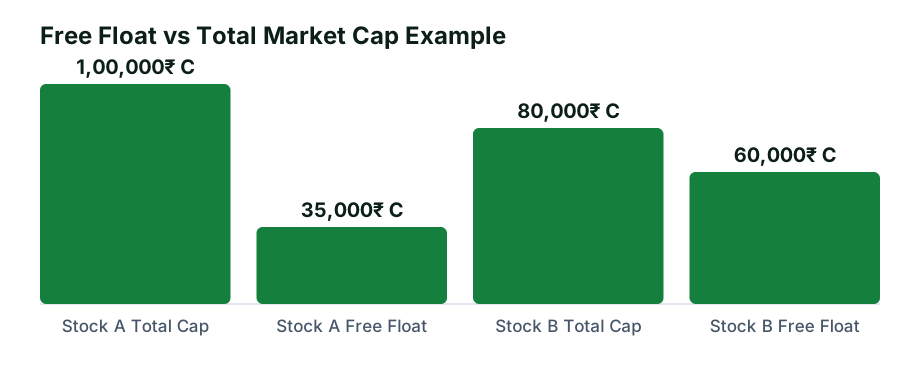
Example: Free Float Weightage Calculation for Two Stocks
Let us walk through a concrete example with two Nifty 50 names so the concept clicks. We will use approximate figures as of 2026, modelled on a large private bank and a large PSU bank, to keep the math clean.
Stock A: A large private bank with no promoter holding
- Total shares: 750 crore
- Share price: ₹1,700
- Total market cap: ₹12,75,000 crore
- Promoter holding: 0 percent
- IWF: 1.0 (essentially full free float, ignoring small locked-in ESOPs for simplicity)
- Free float market cap: ₹12,75,000 crore
Stock B: A large PSU bank
- Total shares: 890 crore
- Share price: ₹800
- Total market cap: ₹7,12,000 crore
- Promoter (Government of India) holding: 57 percent
- IWF: 0.43
- Free float market cap: ₹3,06,160 crore
Now assume a simplified Nifty 50 with just these two stocks. Total free float market cap of the index = ₹12,75,000 + ₹3,06,160 = ₹15,81,160 crore.
| Stock | Total Market Cap | Free Float Market Cap | Nifty Weightage |
|---|---|---|---|
| Stock A (private bank) | ₹12,75,000 cr | ₹12,75,000 cr | 80.6 percent |
| Stock B (PSU bank) | ₹7,12,000 cr | ₹3,06,160 cr | 19.4 percent |
Notice what happens. Stock A has a total market cap only 1.8 times larger than Stock B, but it ends up with more than 4 times the index weightage. The reason is the promoter block in Stock B. Even though Stock B is a ₹7 lakh crore company, only about ₹3 lakh crore of it actually trades, so that is all that counts toward Nifty.
This is why stocks like HDFC Bank, Infosys and ICICI Bank — where promoter holding is zero or near zero — tend to carry outsized Nifty weightage relative to their total market cap ranking. PSU names like SBI, NTPC and Power Grid, despite being among India's largest companies, sit lower in Nifty weightage because the government stake is locked in.
Does Free Float Change Over Time
Yes, and this is something investors often miss. Free float is not a fixed number. It shifts with corporate actions, shareholding changes, and regulatory events.
Common events that change free float:
- Promoter selling or OFS: When promoters or the government sell shares through an Offer for Sale, those shares move into public hands and free float rises.
- FPO and QIP: Fresh issuance to institutional or retail buyers increases free float if the new shares are not locked in.
- ESOP vesting: As employee shares exit the lock-in period, they become tradable and add to free float.
- Buybacks: When a company buys back and extinguishes shares, free float shrinks proportionally.
- Promoter pledging and release: Pledged shares that get released back to the promoter do not by themselves change free float, but they affect perception and often precede selling.
- Lock-in expiries: Shares locked in after an IPO or strategic stake sale become free float once the lock-in ends.
Each of these can shift a stock's Nifty weightage even without any price movement. That is why index reviews matter — NSE recalculates IWFs and rebalances weightage to keep the index aligned with current free float reality.
How Free Float Links to Index Stock Selection
Free float is not just about weightage — it also plays a role in which stocks enter Nifty 50 in the first place. The eligibility criteria for inclusion include listing history, liquidity, and a minimum free float market cap threshold.
A company can be large by total market cap but still fail the liquidity test if most of its shares are locked in. NSE requires that a stock be traded on the derivatives segment and meet impact cost thresholds over six months. Stocks with thin free float tend to fail impact cost tests because there are not enough shares changing hands to absorb large orders without moving the price.
This is why you sometimes see a fast-growing mid-cap with a high promoter stake stay out of Nifty 50 longer than expected — its free float simply is not deep enough yet. For a fuller breakdown of eligibility rules, see how stocks are selected for the Nifty 50 index.
For investors, this also means free float is a quality signal. Companies with diversified ownership, no dominant promoter block, and active institutional participation tend to be more liquid, less prone to sudden price gaps, and easier to enter or exit. Pair this with fundamentals — for example, how to read debt to equity ratio in Indian stocks — and you get a fuller picture of risk.
Free float also interacts with market stability. During extreme moves, how NSE market circuit breakers work depends in part on how broadly held the index is. A Nifty dominated by a few low-free-float names would be more volatile than one with widely held constituents, which is another reason NSE leans on free float.
Frequently asked questions
What is free float market capitalization in simple terms?
It is the market value of a company's shares that are actually available for public trading, excluding locked-in shares held by promoters and governments.
Why does Nifty 50 use free float instead of total market cap?
Using free float ensures that only actively tradable shares influence the index, giving a more accurate picture of market movements and preventing large promoter holdings from skewing weightage.
Does a stock split change free float market capitalization?
No, a stock split does not change free float market cap because the share price falls proportionally while the number of free float shares rises, keeping the total value the same.
How often does NSE update free float factors for Nifty 50?
NSE reviews and updates free float factors periodically, typically at the time of index rebalancing which happens every six months.