If you have ever stared at an annual report and wondered whether a company is drowning in debt, the debt-to-equity ratio is the first number you should learn to read. Knowing how to read debt to equity ratio in Indian stocks tells you whether a company is funding its growth with owner's money or borrowed money — and that single distinction separates a lot of multibaggers from value traps. This guide walks you through the formula, the exact line items to pull from an Indian balance sheet, sector-specific benchmarks, and the blind spots most beginners miss.
What Is Debt to Equity Ratio and Why It Matters
The debt-to-equity ratio (D/E) compares what a company owes to what its shareholders own. In plain terms, it answers one question: for every ₹1 of shareholder money, how many rupees has the company borrowed?
Leverage cuts both ways. When business is good, debt amplifies returns — a company earns a higher return on equity (ROE) because it is using someone else's money to grow. When business turns, debt amplifies losses: interest eats into profits, principal repayments drain cash, and if things go badly enough, lenders take control of the company.
This is why D/E is one of the first fundamental checks in [investing basics]. A company with a clean balance sheet can survive a slowdown, invest through a downturn, and reward shareholders when the cycle turns. A company carrying too much debt is one bad quarter away from a covenant breach, a rating downgrade, or a dilutive equity raise.
For Indian retail investors, D/E is especially useful because the Indian market has a wide mix of debt-light IT services companies and debt-heavy capital goods, power, and infrastructure names. Treating them with the same benchmark is one of the fastest ways to misread a stock.
The Debt to Equity Ratio Formula With an Example
The formula is straightforward:
Debt to Equity Ratio = Total Debt / Total Equity
- Total Debt = Long-term borrowings + Short-term borrowings + Current portion of long-term debt + Lease liabilities (under Ind AS 116)
- Total Equity = Share capital + Reserves and surplus (including retained earnings) — minus accumulated losses, if any
Let's walk through a concrete example using numbers you might see in an Indian annual report.
Worked Example
Say a manufacturing company reports the following on its balance sheet for FY 2026-27:
- Long-term borrowings: ₹1,200 crore
- Short-term borrowings: ₹300 crore
- Current portion of long-term debt: ₹100 crore
- Lease liabilities: ₹50 crore
- Share capital: ₹100 crore
- Reserves and surplus: ₹1,350 crore
Total Debt = 1,200 + 300 + 100 + 50 = ₹1,650 crore Total Equity = 100 + 1,350 = ₹1,450 crore
D/E Ratio = 1,650 / 1,450 ≈ 1.14
A ratio of 1.14 means the company has ₹1.14 of debt for every ₹1 of equity. Whether that is safe depends entirely on the sector — which is why a single universal cutoff is misleading.
Where to Find Debt and Equity in an Indian Balance Sheet
Indian listed companies report under Ind AS, so the balance sheet structure is fairly standard. Here is exactly where to look.
Where to find debt equity ratio in balance sheet
The balance sheet itself doesn't print a "D/E ratio" line. You have to compute it from two sections.
-
Equity — Top of the balance sheet, under "Equity and Liabilities." Look for:
- Equity share capital (the face value of shares multiplied by shares outstanding)
- Other equity (reserves and surplus, retained earnings, securities premium, etc.)
- Add these two. That is your total equity.
-
Debt — Lower in the same "Equity and Liabilities" section, under "Non-current liabilities" and "Current liabilities." Pull these specific line items:
- Long-term borrowings (non-current) — term loans, debentures, external commercial borrowings
- Short-term borrowings (current) — working capital loans, cash credit, overdraft
- Current maturities of long-term debt — the portion of long-term borrowings due within 12 months
- Lease liabilities — both current and non-current portions under Ind AS 116
Do not include trade payables (supplier credit), statutory dues, or unclaimed dividends. Those are operating liabilities, not financial debt.
Where to find the numbers fast
If you don't want to crack open a 300-page annual report, three sources work well:
- Screener.in — shows D/E on the company page, computed from the most recent annual report. Good for a quick scan.
- Moneycontrol — fundamentals section, under "Balance Sheet" and "Ratios" tabs.
- NSE corporate filings page — pull the full annual report directly. Best when you want to verify the number yourself.
For stocks in the [Nifty 50 index], the annual report is the authoritative source. Aggregators sometimes lag by a quarter or misclassify a line item.
What Is a Good Debt to Equity Ratio for Indian Stocks
The honest answer is: it depends on the sector. The popular rule that "D/E should be under 1" works for some industries and is wildly wrong for others.
The "under 1" rule and where it applies
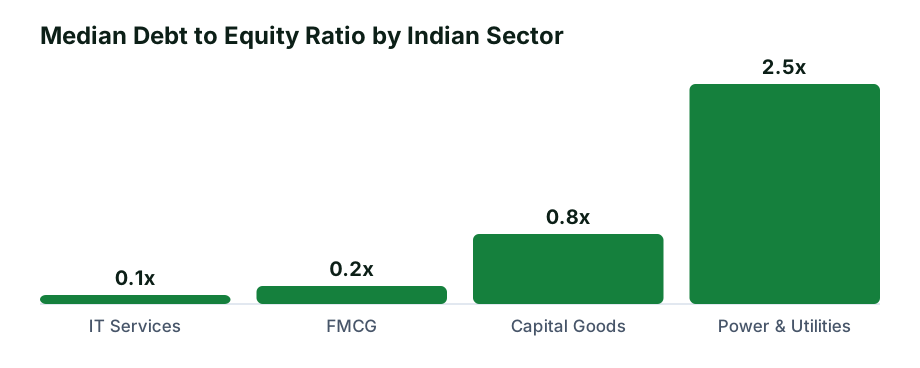
For IT services, FMCG, consumer durables, and pharmaceuticals, a D/E ratio under 1 is a reasonable screen. Many of these companies actually sit at 0.1 to 0.3 because they generate strong cash and don't need debt to grow. A D/E above 1 in these sectors is a yellow flag — it usually means either a recent acquisition funded with debt or a stressed balance sheet.
When higher D/E is normal
For capital-intensive businesses — power, steel, cement, telecom, infrastructure — a D/E of 2 to 3 is common. These companies build plants that take years to pay off, and debt is the cheapest way to fund that. A D/E of 2.5 for a power generator is not automatically a red flag; the same number for an IT services company would be alarming.
When low D/E is a warning
A D/E of 0 is not always good. A company sitting on cash but refusing to deploy it can have a low D/E and a low ROE. If a mature business with predictable cash flows runs zero debt year after year, ask whether management is being too conservative — or whether the business genuinely has no reinvestment opportunity.
Sector-Wise Debt to Equity Ratio Benchmarks in India
This is where most beginners go wrong. They apply one cutoff to every stock. Below are rough benchmarks for Indian sectors, based on typical ranges seen across listed companies in recent years. Use these as a starting screen, not a verdict.
| Sector | Typical D/E range | Why |
|---|---|---|
| IT services | 0.0 – 0.3 | Asset-light, cash-generative, little need for debt |
| FMCG | 0.0 – 0.5 | Strong working capital, high margins |
| Pharmaceuticals | 0.1 – 0.6 | R&D and capex funded mostly from internal accruals |
| Automobiles (4-wheelers) | 0.5 – 1.5 | Capex-heavy, but supported by finance subsidiaries |
| Cement | 0.5 – 1.5 | Limestone reserves and kilns need long-term funding |
| Steel and metals | 1.0 – 2.5 | Cyclical, capital-intensive |
| Power (generation) | 2.0 – 3.5 | Regulated returns, project debt is the norm |
| Telecom | 2.0 – 4.0 | Spectrum and network capex funded largely by debt |
| Infrastructure / EPC | 1.5 – 3.0 | Working capital heavy, receivables stretch the cycle |
| Real estate | 1.0 – 3.0 | Land bank and project construction funded by debt |
These ranges are broad. A company consistently at the top of its sector's range deserves a closer look — check interest coverage, cash flow from operations, and whether debt is falling or rising.
Debt to equity ratio sector benchmarks India — how to use them
The right way to use these benchmarks is relative, not absolute. Compare a cement company with D/E 1.2 to its sector median, not to an IT company at 0.2. If the sector median is 1.0 and your target is at 1.8, that is a 80% premium — worth investigating. If it's at 0.6, the balance sheet is stronger than peers, which is usually a plus in a rising rate cycle.
Why D/E Ratio Does Not Work for Banks and NBFCs
This is the single biggest mistake beginners make. The D/E ratio is meaningless for banks and non-banking financial companies (NBFCs). Here's why.
For a manufacturer, "debt" is money borrowed to run the business. For a bank, customer deposits are reported as liabilities — and they dwarf equity. A bank with ₹1,000 crore in equity might have ₹20,000 crore in deposits, giving it a D/E of 20. That doesn't mean the bank is overleveraged; it means the bank is in the business of taking deposits.
What to use instead
For banks and NBFCs, look at:
- Capital adequacy ratio (CRAR) — the regulatory minimum is 9% for Indian banks under RBI norms; most well-run banks sit at 14–16%.
- Tier 1 capital — the core equity portion. Above 10% is healthy.
- Gross and net NPA ratios — asset quality matters more than leverage.
- Provision coverage ratio — how much of bad loans are provided for.
- Cost-to-income ratio — operating efficiency.
Comparing HDFC Bank's D/E to Hindustan Unilever's D/E tells you nothing. Comparing their CRAR and ROE respectively tells you something useful.
Common Mistakes When Reading D/E Ratio
Even investors who know the formula get tripped up by these issues.
1. Ignoring lease liabilities
Before Ind AS 116 kicked in, operating leases sat off-balance-sheet. Now they show up as lease liabilities on the balance sheet. For retailers, airlines, and logistics companies, lease liabilities can be material. A retail chain might look debt-light at D/E 0.4, but after layering in lease liabilities, the real D/E could be 1.2 or higher. Always include lease liabilities when computing total debt.
2. Using only long-term debt
Many screens report "D/E" using only long-term borrowings. That misses working capital loans and overdrafts — which are very real debt. A company funding daily operations with cash credit is still carrying leverage. Use total debt, not just the long-term portion.
3. Comparing across sectors
We covered this above, but it's worth repeating. A D/E of 2 is normal for a power utility and dangerous for an IT services firm. Always compare within the same sector.
4. Ignoring the trend
One year's D/E is a snapshot. Three years of D/E tells a story. A company moving from 0.8 to 1.2 to 1.6 is adding debt faster than equity — watch interest coverage. A company moving from 2.5 to 2.0 to 1.5 is deleveraging, which is usually a positive signal for the stock.
5. Missing contingent liabilities
Contingent liabilities — corporate guarantees, claims disputed in court, letters of credit — sit off-balance-sheet but can crystallize into real debt. Check the contingent liabilities note in the annual report. A clean D/E with a ₹500 crore contingent liability is not the same as a clean D/E with none.
6. Ignoring promoter pledging
A low D/E at the company level doesn't help if promoters have pledged most of their shares. If the stock falls and lenders invoke the pledge, promoters can lose control — and the stock can crater. Check [promoter pledging] before you trust any fundamental number, D/E included.
7. Treating book value of equity as market value
D/E uses book value of equity from the balance sheet. A company with ₹100 crore book equity and a ₹10,000 crore market cap has a very different risk profile than the D/E ratio alone suggests. For valuation, also look at market-cap-to-debt and enterprise value-to-EBITDA.
How D/E Ratio Fits With Other Fundamental Checks
D/E is one signal, not the whole picture. Pair it with these checks.
Interest coverage ratio
Formula: EBIT / Interest expense. A D/E of 1.5 with interest coverage of 6 is fine. A D/E of 1.5 with interest coverage of 1.5 is on the edge — one bad year and interest eats operating profit. As a rough rule, interest coverage above 4 is comfortable for most non-financial companies; below 2 is a red flag.
Return on equity (ROE)
If a company carries D/E of 2 and ROE of 22%, debt is working for it. If D/E is 2 and ROE is 8%, debt isn't generating enough return to justify the risk. Compare ROE with the cost of borrowing. If ROE is lower than the after-tax cost of debt, leverage is destroying shareholder value.
Cash flow from operations
Profit can be engineered; cash flow is harder to fake. Check whether operating cash flow consistently covers interest plus principal repayments. A company with positive profits but negative operating cash flow for two years running is a warning sign, regardless of what D/E says.
Debt-to-EBITDA
This strips out accounting differences and shows how many years of operating profit it would take to repay all debt. A debt-to-EBITDA above 4 is high for most Indian sectors; above 6 is a stress signal.
Quick Checklist Before You Trust a D/E Number
Before you act on a D/E ratio, run through this list:
- Total debt includes short-term borrowings, current maturities, and lease liabilities — not just long-term loans.
- Equity includes share capital plus reserves and surplus.
- You're comparing the company to its sector benchmark, not a universal cutoff.
- The company is not a bank or NBFC — if it is, switch to CRAR and NPA ratios.
- You've checked the three-year trend, not just the latest year.
- Contingent liabilities are small relative to net worth.
- Interest coverage is above 4 (or the sector norm).
- Operating cash flow covers interest and principal.
- Promoter pledging is low or zero.
- You've verified the number against the annual report, not just a screener.
Run through this and the D/E ratio becomes a real analytical tool instead of a number you glance at and forget.
Frequently asked questions
What is the ideal debt to equity ratio for Indian companies?
For most non-financial companies, a D/E ratio below 1 is considered healthy, but capital-intensive sectors like power and infrastructure routinely operate above 2. The right benchmark depends on the industry — compare within the sector, not against a universal cutoff.
Is a debt to equity ratio of 0 always good?
Not necessarily. Zero debt can mean a strong balance sheet, but it can also mean the company is not using leverage to grow, which may hurt returns on equity. A profitable company with predictable cash flows that refuses to take any debt may be under-leveraged — and shareholders may be paying for that conservatism in the form of lower ROE.
Where can I check debt to equity ratio for NSE stocks?
You can find it on the company's annual report, on screener.in, or in the fundamentals section of moneycontrol and the NSE corporate filings page. For NSE-listed companies, the annual report available on the NSE filings page is the authoritative source; aggregators are good for a quick scan but can lag or misclassify line items.
Why do banks have very high debt to equity ratios?
Banks treat customer deposits as debt, so their D/E ratio looks artificially high and is not comparable with manufacturing or IT companies; use capital adequacy ratios instead. For NBFCs and banks, look at CRAR, Tier 1 capital, gross and net NPA ratios, and provision coverage — those tell you about solvency and asset quality, which D/E cannot.
Does debt to equity ratio include operating leases?
Under Ind AS 116, operating leases are recognised on the balance sheet as lease liabilities, so they are now included in total debt for most listed Indian companies. For sectors like retail, aviation, and logistics where leasing is a big part of the operating model, excluding lease liabilities would understate leverage materially. Always include lease liabilities — both current and non-current — when computing total debt.