
Book value per share (BVPS) is one of the most misunderstood yet powerful metrics for valuing Indian stocks, especially in asset-heavy sectors like banking and insurance. While most retail investors focus on earnings per share or price-to-earnings ratios, they often skip the balance sheet foundation that BVPS reveals—the actual equity backing each share. Understanding BVPS unlocks why some stocks trade at steep discounts to their net asset value, and why the same price-to-book multiple means entirely different things across sectors.
What Is Book Value Per Share (BVPS)?
Book value per share represents the equity value attributable to each outstanding share, calculated directly from the balance sheet. It answers a simple question: if the company liquidated all assets at their balance sheet values and paid off all liabilities, how much would each shareholder own?
BVPS is a backward-looking, balance sheet metric. It reflects the net worth of the company divided by share count—not future earnings or growth potential. This makes it particularly useful for:
- Valuing asset-heavy businesses (banks, insurers, real estate companies) where tangible equity matters
- Identifying undervalued stocks trading below their liquidation value
- Comparing companies in the same sector on a level playing field
- Understanding capital efficiency when paired with profitability metrics
Unlike earnings per share (EPS), which measures profit, BVPS measures the equity foundation itself. A company can have high earnings but low book value if it operates with minimal assets (like software firms). Conversely, a bank might have modest earnings but substantial book value because it holds large asset bases backing deposits.
Book Value Per Share Formula Explained
The formula for BVPS is straightforward:
BVPS = (Total Assets − Total Liabilities) ÷ Number of Outstanding Shares
Or equivalently:
BVPS = Shareholders' Equity ÷ Number of Outstanding Shares
Breaking this down:
- Total Assets: Everything the company owns (cash, receivables, inventory, property, investments, goodwill)
- Total Liabilities: Everything the company owes (loans, payables, provisions, deferred tax liabilities)
- Shareholders' Equity: The residual—what belongs to shareholders after creditors are paid
- Number of Outstanding Shares: Issued shares held by public and promoters (found in the balance sheet or company filings)
All figures come directly from the audited balance sheet, making BVPS a concrete, verifiable number with no estimation or projection involved.
How to Calculate BVPS from NSE/BSE Financials
Here's a worked example using a hypothetical mid-cap bank listed on NSE:
| Item | Amount (₹ Crore) |
|---|---|
| Total Assets | 50,000 |
| Total Liabilities | 45,000 |
| Shareholders' Equity | 5,000 |
| Outstanding Shares | 100 Crore |
BVPS = 5,000 Crore ÷ 100 Crore shares = ₹50 per share
To find these numbers for any NSE or BSE listed company:
- Visit the company's investor relations website and download the latest annual report or quarterly financial statements
- Locate the balance sheet (also called "Statement of Financial Position")
- Find Total Assets and Total Liabilities in the balance sheet summary
- Calculate Shareholders' Equity (Assets − Liabilities) or read it directly if listed
- Find the number of outstanding shares in the notes to accounts, usually under "Share Capital" or "Equity" notes
- Divide Shareholders' Equity by shares outstanding
Alternatively, financial data aggregators like Moneycontrol, BSE/NSE official portals, and stock screeners often display BVPS directly. However, calculating it yourself ensures accuracy and deepens your understanding of the underlying balance sheet.
Important note: Use the most recent audited balance sheet (annual or latest quarterly). BVPS changes quarterly as the company accumulates profits or incurs losses.
Book Value Per Share vs Market Price: The Gap
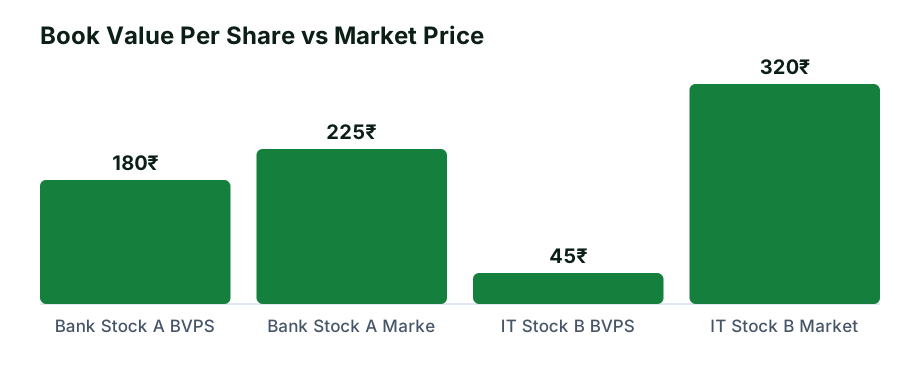
The gap between BVPS and the market price per share reveals investor sentiment and capital efficiency.
| Scenario | Market Price | BVPS | P/B Ratio | Interpretation |
|---|---|---|---|---|
| Growth stock (IT/Tech) | ₹2,000 | ₹200 | 10.0x | Market prices in future growth; book value undervalues intangible assets |
| Undervalued bank | ₹400 | ₹500 | 0.8x | Stock trades below net asset value; potential value opportunity |
| Mature, stable company | ₹600 | ₹600 | 1.0x | Market price equals book value; fair valuation on assets |
| Distressed company | ₹100 | ₹800 | 0.125x | Market doubts asset quality or future viability |
When market price exceeds BVPS (P/B ratio over 1.0x), investors are paying a premium for expected future returns. When market price falls below BVPS (P/B ratio under 1.0x), the stock trades at a discount—either a buying opportunity or a warning sign that asset quality is questioned.
The price-to-book ratio uses book value per share as its numerator, making BVPS essential for understanding valuation multiples across sectors.
Why BVPS Matters for Different Sectors
BVPS relevance varies dramatically by industry:
High relevance sectors:
- Banking: Deposits (liabilities) are backed by assets; BVPS reflects capital adequacy and depositor safety
- Insurance: Premiums collected create liabilities (claims); BVPS shows solvency margin
- Real Estate: Assets are primarily land and buildings; BVPS approximates net asset value
- Manufacturing: Tangible assets (plant, machinery) dominate the balance sheet
Lower relevance sectors:
- IT and Software: Most value comes from intellectual property and human capital—not captured as assets on balance sheets
- Pharma: Patent portfolios and R&D are expensed, not capitalized as assets
- Consumer brands: Brand value and customer loyalty are intangible and off-balance-sheet
For a banking stock, BVPS is a primary valuation anchor. For a software company, BVPS is nearly meaningless—investors care about earnings growth and return on equity instead.
Book Value Per Share in Bank and Insurance Stocks
Banks and insurers are where BVPS shines as a valuation tool.
Why BVPS matters for banks:
- Regulatory capital requirements are tied to equity (Tier 1 and Tier 2 capital under Basel III)
- Depositors' safety depends on the equity cushion backing the loan book
- A bank with low BVPS relative to assets suggests thin capital buffers and higher risk
For example, if Bank A has ₹100 crore in assets and ₹5 crore in equity (5% equity-to-assets), its BVPS is thin relative to its loan book. If Bank B has the same assets but ₹10 crore equity (10% equity-to-assets), its BVPS is stronger—more cushion for loan losses.
Why BVPS matters for insurers:
- Premiums collected are liabilities (claims reserves); BVPS shows the equity backing these obligations
- Solvency regulations require minimum BVPS multiples relative to claims
- A low BVPS insurer has weak capacity to absorb claim spikes
When comparing two bank or insurance stocks, a higher BVPS often signals stronger financial health—provided the company is also generating returns on that equity (measured by return on equity (ROE) relates directly to book value and profitability).
Common Mistakes When Reading BVPS
Mistake 1: Ignoring asset quality BVPS assumes all balance sheet assets are worth face value. In reality, a bank with stressed loans or an insurer with poor underwriting may have overstated assets. Always review asset quality metrics (non-performing assets ratio, solvency ratio) alongside BVPS.
Mistake 2: Comparing BVPS across sectors A P/B ratio of 1.5x is cheap for a bank but expensive for a software company. Always compare BVPS and P/B within the same sector.
Mistake 3: Treating BVPS as a growth metric BVPS is static—it doesn't predict future earnings or dividends. A company with high BVPS but zero ROE is destroying shareholder value. Pair BVPS with profitability metrics.
Mistake 4: Overlooking intangible assets Goodwill and intangible assets on the balance sheet may not represent real economic value. Check the notes to accounts to understand what's included in BVPS.
Mistake 5: Using outdated BVPS Balance sheets change quarterly. Using BVPS from last year's annual report can be misleading if the company has since issued new shares, incurred large losses, or acquired assets.
Using BVPS Alongside Price-to-Book Ratio
BVPS gains power when combined with other metrics. The price-to-book ratio uses book value per share as its numerator, and understanding both together reveals valuation gaps.
A three-step framework:
- Calculate or find BVPS for the stock and its sector peers
- Calculate P/B ratio (Market Price ÷ BVPS)
- Check ROE to see if the company justifies its P/B premium or discount
For instance:
- Bank trading at 0.9x P/B with 15% ROE: Undervalued—strong returns on cheap book value
- Bank trading at 1.5x P/B with 8% ROE: Expensive—weak returns despite premium valuation
- Tech stock at 8x P/B with 40% ROE: Justified—high returns justify premium to book value
The balance sheet fundamentals that feed into book value underpin all equity valuation. Mastering BVPS is a gateway to understanding balance sheet strength.
Frequently asked questions
What is the difference between book value per share and earnings per share?
Book value per share (BVPS) shows the equity value backing each share from the balance sheet; earnings per share (EPS) shows annual profit allocated to each share. BVPS is a stock metric; EPS is an income metric. BVPS tells you what shareholders own; EPS tells you what they earned this year. A company can have high BVPS but low EPS (or vice versa), and both matter for different investment decisions.
Is a high book value per share always good?
Not necessarily. High BVPS only matters if the company generates strong returns on that equity (measured by ROE). A company with high BVPS but low ROE is tying up capital inefficiently—shareholders would be better off if the company returned excess capital or invested in higher-return projects. Always pair BVPS with profitability metrics.
How do I find book value per share for NSE and BSE listed companies?
Calculate it manually using the formula (Total Assets – Total Liabilities) ÷ Number of Outstanding Shares, or check financial websites like BSE/NSE official portals, Moneycontrol, or company investor relations pages that often list BVPS directly. The most reliable source is the company's audited balance sheet in the annual report or quarterly filing.
Why do bank stocks often trade at lower price-to-book ratios than IT stocks?
Banks and insurers are asset-heavy and regulated; their book value reflects tangible equity backing deposits and claims. IT and tech companies have intangible assets (intellectual property, brand) not fully captured on balance sheets, so investors price them on earnings growth, not book value. A bank's value is anchored to its net asset value; a software firm's value is anchored to future cash flows.
Can book value per share be negative?
Yes—if total liabilities exceed total assets, shareholders' equity becomes negative, resulting in negative BVPS. This signals financial distress and is a red flag for investors. A company with negative BVPS has eroded its equity base through sustained losses and may face solvency issues or restructuring.
For deeper dives into balance sheet analysis and valuation fundamentals, explore more fundamental analysis guides.