
If you are learning how to read price to book ratio in Indian stocks, you are looking at one of the oldest and most direct ways to measure whether a company is cheap or expensive relative to its net worth. This ratio compares the market price of a share to the accounting value of the company's assets minus its liabilities. Here is a practical, India-specific guide on calculating it, interpreting it across NSE and BSE sectors, and applying it to your value screening for FY 2026-27.
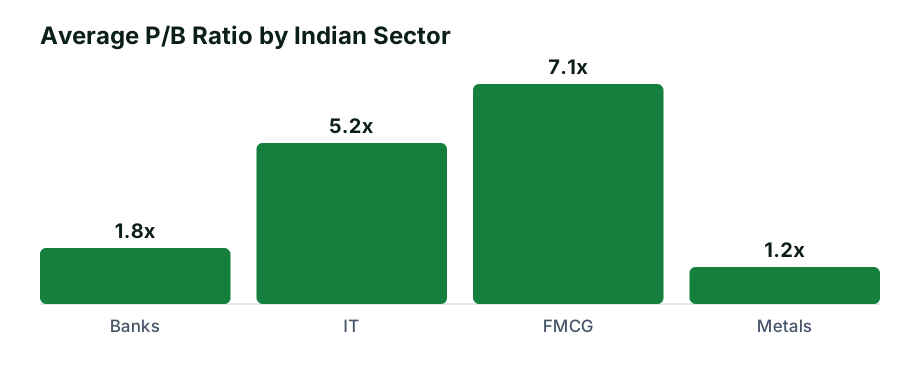
What Is the Price to Book (P/B) Ratio in Stocks?
The p b ratio meaning in stock market is straightforward: it tells you how much investors are paying for every rupee of a company's book value. Book value is essentially the accounting net worth of the company — what would be left for shareholders if the company sold all its assets and paid off all its liabilities today.
When you buy a stock, you are buying a slice of the company's equity. The market price reflects what investors expect that slice to be worth in the future, factoring in growth, brand value, and earnings power. The book value reflects what that slice is worth on the balance sheet today, based on historical cost minus depreciation.
The price to book value ratio explained India context becomes useful because Indian markets have a huge variety of businesses. Some companies own massive physical assets — factories, land, machinery — which sit clearly on the balance sheet. Other companies own almost nothing physically but generate massive profits through intangible assets like software code, brand reputation, or human capital. The P/B ratio helps you separate the asset-heavy bargains from the overhyped asset-light stocks.
How to Calculate the P/B Ratio with a Simple Example
The p b ratio calculation with example requires only two numbers: the current market price per share and the book value per share (BVPS).
Formula: P/B Ratio = Market Price per Share / Book Value per Share
To find Book Value per Share, you take the total equity capital and reserves on the company's balance sheet, subtract any intangible assets and preference share capital, and divide by the number of outstanding equity shares.
Example: State Bank of India (SBI)
Let's say SBI's share price is ₹820. You pull up SBI's latest balance sheet for FY 2025-26.
- Total equity (share capital plus reserves) = ₹3,50,000 crore
- Intangible assets = ₹5,000 crore
- Tangible net worth = ₹3,45,000 crore
- Number of outstanding shares = 890 crore
- Book Value per Share = ₹3,45,000 crore / 890 crore = ₹387.64
P/B Ratio = ₹820 / ₹387.64 = 2.11
This means SBI is trading at roughly 2.1 times its book value. You are paying ₹2.11 for every ₹1 of tangible net worth on the bank's balance sheet.
Example: Tata Motors
Let's say Tata Motors trades at ₹980. Its balance sheet shows total equity of ₹1,15,000 crore and outstanding shares of 370 crore. If intangible assets are ₹4,000 crore, the tangible net worth is ₹1,11,000 crore.
- Book Value per Share = ₹1,11,000 crore / 370 crore = ₹300
- P/B Ratio = ₹980 / ₹300 = 3.26
Tata Motors trades at over 3 times book. This is typical for an auto company with strong brands and future growth expectations priced in.
What Is a Good P/B Ratio for Indian Stocks?
If you are asking what is a good p b ratio for NSE stocks, the honest answer is that it depends entirely on the sector and the company's return on equity. A blanket number does not work.
Here is a practical benchmarking table for Indian sectors in 2026:
| Sector | Typical P/B Range | Reason |
|---|---|---|
| Public Sector Banks | 0.8 to 1.5 | High asset base, lower RoE, legacy NPAs |
| Private Sector Banks | 2.0 to 4.0 | Higher RoE, cleaner books, strong growth |
| NBFCs | 2.5 to 5.0 | Leverage amplifies equity returns |
| IT Services | 4.0 to 8.0 | Asset-light, high cash generation |
| FMCG | 6.0 to 15.0 | Brand value not on balance sheet |
| Auto and Manufacturing | 2.0 to 4.0 | Asset-heavy, cyclicality priced in |
| Metals and Mining | 0.8 to 2.0 | Cyclical, commodity-driven earnings |
| Pharma | 3.0 to 6.0 | IP and brand value partially excluded |
A stock trading at a P/B of 0.8 sounds cheap, but if it is a metal company in a downturn, the book value might be inflated by overvalued inventory or plant machinery that cannot actually be sold for the balance sheet price. A stock trading at a P/B of 8 sounds expensive, but if it is Hindustan Unilever, the book value misses the ₹40,000 crore brand value that generates massive returns year after year.
Why the P/B Ratio Works Best for Banking and Asset-Heavy Sectors
For banks and non-banking financial companies (NBFCs), the P/B ratio is arguably the single most important valuation metric. Here is why.
Assets Are Financial and Marked to Market
A bank's assets are mostly loans, bonds, cash, and investments. These are financial assets, not physical machinery. Under RBI regulations, Indian banks must classify assets and provision for bad loans. A large chunk of a bank's balance sheet is marked to market or assessed quarterly for impairment. This means the book value of a bank is far closer to reality than the book value of a manufacturing company, where a 20-year-old factory might still sit on the books at original cost minus depreciation.
Equity Is the Cushion
Banking is a leveraged business. A bank might have ₹10,000 crore in equity supporting ₹1,50,000 crore in assets. That equity is the cushion that absorbs losses before depositors take a hit. When you buy a bank at a P/B of 1.2, you are paying a 20 percent premium over that cushion. If the bank's Return on Equity is 15 percent and growing, a P/B of 1.2 to 2.0 is reasonable. If the RoE is stuck at 8 percent, even a P/B of 0.8 is expensive because the bank is not generating enough to justify its capital base.
PSB vs Private Bank Screening
Public sector banks often trade at a P/B below 1. This is not always a bargain. It reflects lower RoE, higher gross non-performing asset ratios, and government ownership discounts. Private banks like HDFC Bank or ICICI Bank trade at higher P/B multiples because their RoE is consistently above 15 percent and asset quality is better. When you screen banks in FY 2026-27, compare P/B within sub-categories — private banks to private banks, not a private bank to State Bank of India.
Manufacturing and Capital Goods
For asset-heavy sectors like steel, cement, capital goods, and power, the P/B ratio anchors you to replacement cost. If a cement company is trading below the replacement cost of its plants, a competitor could theoretically buy it cheaper than building fresh capacity. This creates a floor on valuation. In a downturn, a cement stock at a P/B of 0.9 might be a deep value buy if demand is recovering, because the assets on the balance sheet are real and productive.
Limitations of Using P/B Ratio for IT and Service Companies
The P/B ratio is misleading for asset-light businesses. If you apply a banking-style P/B filter to IT stocks, you will conclude that TCS and Infosys are absurdly overpriced every single year. You will miss the entire rally.
Intangible Assets Are Missing
TCS generates over ₹45,000 crore in net profit annually. Its balance sheet equity is large, but most of its real value sits in client relationships, proprietary software platforms, delivery frameworks, and employee skills. None of these appear on the balance sheet as assets under Indian accounting standards. If TCS has a book value per share of ₹250 and a market price of ₹4,000, the P/B of 16 looks insane. But the book value is not capturing the actual earning power of the business.
FMCG and Pharma Brand Value
Hindustan Unilever's brands — Surf, Lifebuoy, Dove — are worth tens of thousands of crores. They sit off-balance-sheet. The book value of HUL might be ₹50 per share while the stock trades at ₹2,500. A P/B of 50 is meaningless here. You are paying for brand cash flows, not for factories and warehouses. The same applies to pharma companies where the real value is in approved drug filings and regulatory licenses, not in the physical plant.
Cash Heavy Service Firms
Some Indian service companies hold massive cash piles that inflate book value. If a BPO firm has ₹5,000 crore in cash and no debt, the book value looks healthy. But if the operating business is shrinking, the P/B of 1.2 is not a bargain — you are buying a low-returning cash pile. You need to strip out cash and look at enterprise value to operating earnings, not just P/B.
High RoE Makes P/B Less Relevant
If a company consistently earns a 30 percent return on equity, it compounds book value rapidly. A P/B of 8 today might be a P/B of 4 in three years even if the stock price stays flat, because book value catches up. For high-RoE franchises, use P/E or EV/EBITDA, not P/B.
How to Combine P/B Ratio with ROE for Better Screening
The P/B ratio alone is a weak signal. The P/B ratio paired with RoE is a powerful signal. This pairing comes from the DuPont analysis framework — a company's valuation should logically track its return on equity.
The Justified P/B Formula
A useful approximation: Justified P/B = (RoE - Growth Rate) / (Cost of Equity - Growth Rate)
If a bank has an RoE of 15 percent, a cost of equity of 11 percent, and a long-term growth rate of 9 percent, the justified P/B is (15 - 9) / (11 - 9) = 6 / 2 = 3.0. The market should rationally pay 3 times book for that bank. If the stock is trading at a P/B of 1.5, it is undervalued. If it is trading at a P/B of 4.5, it is overvalued.
Screening Checklist for FY 2026-27
When you build a value screen for Indian stocks this year, stack these filters:
- P/B less than 1.5 for banks and financials, or less than 2 for manufacturing
- RoE above 12 percent to ensure the book value is productive
- debt to equity ratio under 1 for manufacturing, or under 6 for banks (leverage is normal in banking)
- current ratio above 1.2 to confirm short-term solvency
- Net profit positive and growing for the last three years
A stock that passes all five filters is a genuine value candidate. A stock that passes only the P/B filter is a value trap candidate.
Watch for Write-Downs
If a company's book value per share drops sharply year-on-year, investigate. It could be an asset impairment, a massive loss, or a writedown of inventory. A falling book value pushes the P/B ratio up even if the stock price falls. Always read the last two annual reports before trusting the P/B number on a screener.
Using P/B Ratio for Value Investing in FY 2026-27
The Indian market in 2026 is layered. Large-cap indices are near all-time highs, but several mid-cap and small-cap pockets — especially in PSU banks, metals, and old-economy manufacturing — still show reasonable P/B multiples. Applying the P/B ratio correctly can help you avoid paying silly prices for fashionable stocks and find overlooked businesses.
Sector-Specific Application
For banks in FY 2026-27, the P/B is your primary valuation anchor. HDFC Bank, post-merger with HDFC Ltd, has seen its P/B compress because the merged entity's book value expanded. ICICI Bank trades at a premium P/B reflecting its RoE trajectory. SBI trades at a discount, reflecting its PSB status but improving RoE. A value investor should compare the P/B-to-RoE ratio across these three banks rather than just picking the lowest P/B.
For manufacturing, the P/B helps you spot capacity expansion stories. If a capital goods company is trading at a P/B of 2.5 but has just commissioned a new plant that doubles its book value, the forward P/B might be 1.3. The trailing ratio looks expensive, the forward ratio is cheap.
For IT and FMCG, skip the P/B entirely. Use P/E relative to earnings growth, free cash flow yield, and dividend yield. The book value in these sectors is an accounting artifact, not a valuation anchor.
Avoiding Value Traps
A low P/B ratio in a dying sector is a trap. If a printing press company trades at a P/B of 0.6, the assets on the balance sheet — old printing machines, unsold inventory — may have a realizable value of 20 cents on the rupee. The book value is inflated. The market is correctly pricing the stock at a discount because the assets will never earn their historical cost back.
Verify asset quality. Look at the fixed asset turnover ratio. If net sales divided by net fixed assets is falling year after year, the assets are becoming unproductive. A low P/B on unproductive assets is not a value buy.
Book Value per Share vs Face Value
Do not confuse book value with the face value of a share. Face value is a nominal number — usually ₹1, ₹2, ₹5, or ₹10 — set at the time of incorporation. It is used for accounting and dividend calculations. Book value is the actual net worth per share, calculated from the balance sheet. A share with a face value of ₹2 can have a book value of ₹500 and a market price of ₹5,000. The P/B ratio uses book value, never face value. Beginners often confuse the two and end up calculating a meaningless ratio.
Practical Workflow
Here is how a working Indian value investor uses P/B in FY 2026-27:
- Start with a screener like Screener.in or Trendlyne.
- Filter for P/B under 1.5 if screening financials, under 2.5 if screening manufacturing.
- Sort by RoE descending.
- Discard companies with a falling book value per share over five years.
- Read the latest annual report for asset quality, intangible asset share, and impairment notes.
- Compare the P/B to the company's own 10-year median P/B to spot cyclical lows.
- Confirm with Return on Equity and debt to equity ratio.
This workflow filters out the noise and gives you a shortlist of asset-rich, productive businesses trading at reasonable valuations.
Frequently asked questions
What is a good P/B ratio for Indian stocks?
A P/B ratio below 1 suggests a stock is trading below its book value, which may indicate undervaluation, but context matters — banking stocks often trade below 1 while IT stocks trade much higher.
Is a low P/B ratio always a buy signal?
No, a low P/B ratio can also signal that the market expects poor future earnings or that the company's assets are overvalued on its balance sheet.
Why is P/B ratio more useful for banks than IT companies?
Banks have assets that are mostly financial and marked to market, making book value reliable, whereas IT companies derive value from intangible assets that do not fully appear on the balance sheet.
How is P/B ratio different from face value?
Face value is a nominal accounting value set at incorporation, while book value is the actual net worth per share calculated from total assets minus total liabilities.