
If you have ever opened a company's shareholding pattern and noticed a line item called "pledged shares," you have encountered one of the most important and often ignored red flags in Indian investing. This guide explains exactly what is promoter pledging in Indian stocks, why promoters do it, where to find the pledging percentage on NSE and BSE filings, and what thresholds should make you think twice before buying.
What Is Promoter Pledging of Shares?
Promoter pledging is the practice where a company's promoters — the founders, controlling shareholders, or promoter group entities — use their own shares as collateral to secure a loan. The shares are legally handed over to a lender (a bank, NBFC, or financial institution) as security. Until the loan is repaid, the lender holds the right to sell those shares if the borrower defaults or if certain conditions are breached.
The pledged shares meaning in stock market terms is straightforward: these are shares that have been locked up as collateral. The promoter still technically owns them and may continue to receive dividends and voting rights in many cases, but the lender has a claim on them. If the promoter fails to repay the loan or if the share price falls below an agreed threshold, the lender can invoke the pledge — meaning they can sell the shares in the open market to recover their money.
In the Indian context, promoter pledging is disclosed in the quarterly shareholding pattern filed by every listed company with NSE and BSE. SEBI mandates this disclosure so that retail investors can see exactly how many promoter shares are encumbered. The promoter pledging meaning is not just an accounting technicality — it is a signal of how financially stretched the promoter is, and how much risk the stock carries if things go wrong.
How the mechanics work
When a promoter pledges shares, the process typically works like this:
- The promoter approaches a lender for a loan — either for personal use, for another group company, or sometimes for the listed company itself.
- Shares are transferred to a demat account controlled by the lender (or marked as pledged in the depository system).
- The lender applies a "haircut" — they lend less than the full market value of the shares. For example, if shares worth ₹100 crore are pledged, the lender might only lend ₹60-70 crore.
- If the share price falls, the lender may ask for more collateral (a margin call). If the promoter cannot provide it, the lender invokes the pledge.
- Upon repayment, the pledge is released and shares return to the promoter's free demat account.
Why Do Indian Promoters Pledge Shares?
Promoters pledge shares for a variety of reasons, and not all of them are alarming. Understanding the "why" is essential before judging whether the pledging is acceptable or dangerous.
Common reasons for pledging
- Working capital or business funding: Promoters may pledge shares to raise funds for the company or a group company when bank loans are expensive or hard to secure.
- Leverage for expansion: A promoter may want to invest in a new venture, acquire another company, or bid for a project without selling their stake in the listed entity.
- Personal liquidity needs: Promoters are often wealthy on paper but cash-poor. Pledging allows them to access liquidity without diluting ownership.
- Margin funding for other investments: Some promoters pledge shares in one company to fund investments in another, sometimes within the same group.
- Debt restructuring: When a group company is in financial distress, promoters may pledge shares of a healthier listed company to raise rescue capital.
The concern arises when pledging is done not for productive use but to mask deeper financial stress. If a promoter is repeatedly pledging more shares, or if the pledging percentage is rising quarter after quarter, it often signals that the promoter is running out of other options to raise money. That is when retail investors need to pay attention.
How to Check Promoter Pledging on NSE and BSE
This is the practical part. SEBI requires every listed company to file a quarterly shareholding pattern within 21 days of the end of each quarter. This filing contains a dedicated section on promoter pledging. Here is how to find promoter pledging percentage on NSE and BSE.
Step-by-step: Finding pledged shares on NSE
- Go to the NSE website (nseindia.com) and search for the company using the search bar or the "Equity" tab.
- On the company's stock page, look for the "Corporate Information" or "Company Information" section.
- Navigate to "Shareholding Pattern" — this is usually under the "Financials" or "Corporate" tab.
- Select the latest quarter. The filing is also available under the "Corporate Filings" section.
- Look for a table row titled "Number of Shares Pledged" or "Pledged Shares" under the promoter category.
- The filing will show:
- Total number of promoter shares
- Number of pledged shares
- Percentage of promoter holding that is pledged
Step-by-step: Finding pledged shares on BSE
- Visit bseindia.com and enter the company name or BSE code in the search bar.
- On the company page, go to the "Shareholding Pattern" section under "Investors" or "Corporate Information."
- Select the most recent quarter.
- The BSE format is similar to NSE — look for the "Pledged/Encumbered" column under the promoter category.
- You will see both the absolute number of pledged shares and the percentage.
What the shareholding pattern shows
The shareholding pattern is a standardized format prescribed by SEBI. The relevant portion looks like this:
| Category | Total Shares | Pledged Shares | Pledged as % of Promoter Holding |
|---|---|---|---|
| Promoter and Promoter Group | 50,00,000 | 12,50,000 | 25% |
| Public | 30,00,000 | — | — |
If you want to know how to check pledged shares in shareholding pattern efficiently, the key is to look at the "Encumbered" or "Pledged" column specifically under the promoter row. Do not confuse this with the total public shareholding — the pledging disclosure is only relevant for the promoter category.
You can also use third-party screener tools like Screener.in, Trendlyne, or the NSE/BSE corporate filings portal to get a quick snapshot. However, always cross-check with the original exchange filing because third-party data can sometimes lag by a quarter or contain formatting errors.
What Pledging Percentage Is Considered Risky?
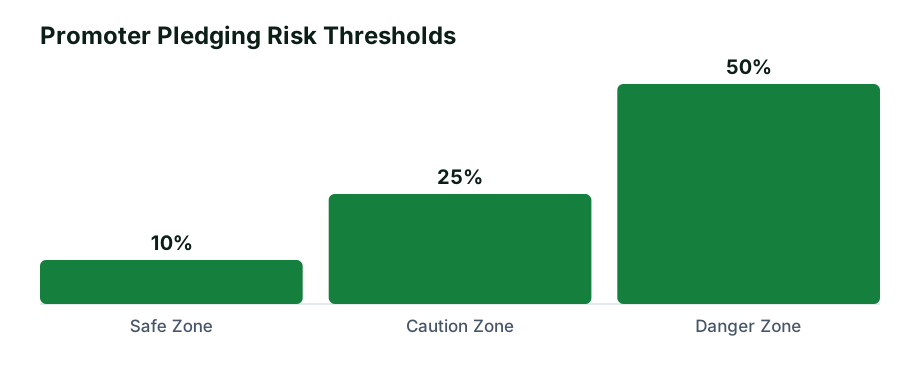
There is no single magic number, but experienced Indian investors use rough thresholds to gauge risk. The table below summarizes how the market typically interprets different pledging levels:
| Promoter Pledging % of Promoter Holding | Risk Level | Interpretation |
|---|---|---|
| 0% | None | Ideal. Promoter has not encumbered any shares. |
| Under 10% | Low | Generally acceptable. May be for routine funding. |
| 10% to 25% | Moderate | Monitor closely. Check if it is rising quarter-on-quarter. |
| 25% to 50% | High | Significant concern. Investigate why the promoter needs this much leverage. |
| Above 50% | Very High | Red flag. Promoter is heavily leveraged and risks losing control. |
| Above 75% | Extreme | Avoid territory. Invocation can cause catastrophic price damage. |
The question of is promoter pledging good or bad cannot be answered with a binary yes or no. A company with 5 percent pledging for a legitimate, disclosed business purpose is very different from a company where 60 percent of promoter shares are pledged and the percentage has been climbing for four straight quarters.
Context matters
A few things to check alongside the pledging percentage:
- Trend: Is pledging increasing or decreasing over the last 4-6 quarters? Rising pledging is more worrying than a stable or falling number.
- Reason: Some companies disclose the reason for pledging in their annual report or in notes to accounts. If the reason is opaque, that itself is a concern.
- Promoter holding size: If promoters hold 70 percent of the company and pledge 10 percent of that, the absolute number of pledged shares is still small relative to total shares. If promoters hold only 20 percent and pledge 80 percent of that, the risk is far higher.
- Stock liquidity and volatility: A volatile stock is more likely to trigger margin calls on pledged shares. Understanding how NSE and BSE circuit breakers work helps you gauge how fast a stock can fall before lenders act.
Risks of High Promoter Pledging for Retail Investors
High promoter pledging creates a specific set of risks that are different from ordinary business risk. Here is what can go wrong.
1. Invocation and forced selling
The biggest risk is invocation. If the promoter defaults or if the share price falls below the lender's threshold, the lender sells the pledged shares in the open market. This is not a gradual, planned sale — it is often a sudden, large block of shares hitting the market, which can crush the price within minutes.
2. Downward spiral
Here is the dangerous feedback loop: the stock falls, triggering a margin call. The promoter cannot meet the margin call, so the lender invokes and sells shares. That selling pushes the price down further, triggering more margin calls on remaining pledged shares. This is how stocks can fall 30-50 percent in a matter of days. The circuit breaker system is the only thing that slows this, and even then, the damage can be severe by the time trading resumes.
3. Loss of promoter control
If a large chunk of pledged shares is invoked and sold to the public, the promoter's stake shrinks. In extreme cases, the promoter can lose controlling interest in their own company. A promoter with reduced skin in the game is less aligned with minority shareholders.
4. Signal of financial distress
High pledging often signals that the promoter or the group is financially stretched. If they had access to cheaper, less risky funding, they would use it. Pledging shares is frequently a last resort when conventional borrowing channels are exhausted.
5. Corporate governance concerns
Sometimes the funds raised by pledging shares are routed to opaque group companies or used for purposes that benefit the promoter personally rather than the listed entity. This is a governance red flag that is hard to detect but worth investigating through the related-party transactions section of the annual report.
Promoter Pledging vs Promoter Holding: Key Differences
Many new investors confuse promoter pledging with promoter holding. They are related but distinct concepts, and understanding the difference matters when you evaluate a stock.
| Aspect | Promoter Holding | Promoter Pledging |
|---|---|---|
| What it measures | Total percentage of company shares held by promoters | Percentage of promoter shares used as collateral |
| Disclosure location | Shareholding pattern (quarterly) | Shareholding pattern, separate column |
| Ideal level | Typically 45-65% for founder-led companies | 0% is ideal |
| Risk implication | Low holding may mean low skin in the game | High pledging means encumbered, risky shares |
| Changes due to | Buybacks, open market purchases, stake sales | New loans, repayment, invocation, margin calls |
| What it tells you | Who controls the company and alignment | How financially stretched the promoter is |
A company can have high promoter holding (say, 65 percent) and still have 50 percent of that pledged. That means the promoter controls the company but is financially leveraged against it. Conversely, a company with 35 percent promoter holding and zero pledging may have lower promoter control but no encumbrance risk.
Both metrics matter, but they tell you different things. Promoter holding tells you about alignment and control. Promoter pledging tells you about financial stress and invocation risk.
Should You Avoid Stocks with Pledged Promoter Shares?
The short answer: not necessarily, but you should treat high pledging as a serious filter that requires deeper investigation before you invest.
When pledging is acceptable
- Pledging is under 10 percent of promoter holding.
- The reason is clearly disclosed and is for a productive business purpose such as working capital or expansion.
- The pledging percentage has been stable or declining over several quarters.
- The company has strong fundamentals — healthy cash flows, low debt-to-equity, and consistent return on equity.
- The promoter group has a clean track record with no history of invocation or governance issues.
When to stay away
- Pledging is above 25-30 percent and rising quarter after quarter.
- The reason for pledging is not disclosed or is vague.
- The company already has high debt on its balance sheet.
- The promoter group has other distressed companies.
- The stock is illiquid, meaning any forced selling will have an outsized price impact.
- There is a history of margin calls or near-invocations in the past.
How to use pledging as a filter
Promoter pledging should be one of several filters you apply before buying a stock. It is not a standalone buy or sell signal. Combine it with checks on:
- Earnings growth and consistency over 5-10 years
- Debt levels and interest coverage ratio
- Cash flow generation relative to reported profits
- Return on equity and return on capital employed
- Promoter holding trend (is it rising, stable, or falling?)
- Related-party transactions and their disclosed rationale
- Valuation relative to peers and the company's own historical range
If you are new to building this kind of checklist, start with investing basics for Indian stock market resources and build your screening process step by step. The goal is not to find companies with zero pledging — many good companies have some pledging — but to understand why it exists and whether the risk is compensated by the fundamentals.
A practical approach
For most retail investors, a simple rule works well: treat any pledging above 25 percent as a reason to dig deeper, and treat anything above 50 percent as a reason to either avoid the stock or size the position very small. If you are already holding a stock and pledging rises sharply in a subsequent quarter, reassess your thesis. Do not wait for invocation to act — by then, the price damage is often already done.
You can explore more FinanceCity guides on Indian markets to build a complete framework for evaluating stocks beyond just this one metric.
Frequently asked questions
Is promoter pledging always bad for a stock?
No, promoters may pledge shares for legitimate business funding, but pledging above 25 percent of promoter holdings is a significant red flag. The context, trend, and disclosed reason matter as much as the absolute number.
Where can I find promoter pledging data for NSE stocks?
Check the quarterly shareholding pattern on the NSE or BSE website under the company's corporate filings section. The filing is made within 21 days of each quarter ending and includes a dedicated column for pledged shares under the promoter category.
What happens when pledged promoter shares are invoked?
Lenders sell the pledged shares in the open market, which can cause a sudden price crash and reduce the promoter's ownership stake. This forced selling often triggers further margin calls on remaining pledged shares, creating a downward spiral.
What is a safe promoter pledging percentage?
Zero pledging is ideal, but anything under 10 percent of total promoter holding is generally considered low risk. Between 10 and 25 percent is a watch zone, and above 25 percent requires serious investigation before investing.
Can promoter pledging lead to a stock crash?
Yes, if lenders invoke pledged shares during a price decline, forced selling can trigger a sharp downward spiral in the stock price. The impact is especially severe in illiquid stocks where even moderate selling can move the price dramatically.