
When you open a demat statement or read an IPO prospectus, you'll notice a small figure called "face value" printed next to each share — usually ₹10, ₹5, ₹2, or Re 1. If you're searching what is face value of a share in stock market, the short answer is that it is the nominal value a company assigns to each share at incorporation, but the practical story is more interesting: it shapes how dividends are declared, how stock splits work, and how your holdings are shown after a corporate action. We break down the face value of share meaning in India with real NSE and BSE examples so you can read your contract notes and corporate-action emails without second-guessing.
What is face value of a share in stock market
Face value (also called par value or nominal value) is the original value of a share as stated in the company's memorandum of association at the time it is incorporated. It is an accounting figure decided by the promoters and is printed on the share certificate. It is not the price at which the share trades, and it does not change when the share price rises or falls on NSE or BSE.
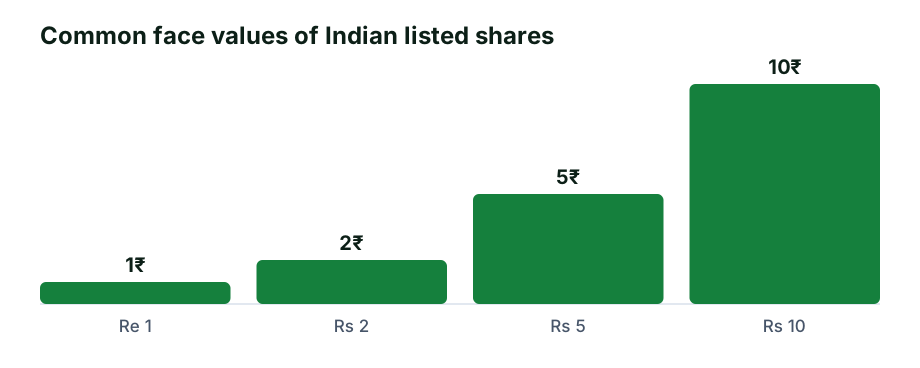
In India, the most common face values you'll see are ₹10, ₹5, ₹2 and Re 1. Some older companies still carry ₹100 or ₹1,000 face value shares, but this is rare today. When a company issues shares for the first time — in an IPO or to promoters — any amount paid above the face value goes into a separate balance-sheet bucket called the "securities premium account." So if a company with a ₹10 face value issues a share at ₹110, ₹10 is credited to share capital and ₹100 to securities premium.
Why does this matter to a retail investor? Because face value is the anchor for several corporate actions — dividend declarations, stock splits, bonus issues, and rights issues are all expressed as a function of face value. Knowing how to read it tells you whether a "100% dividend" announcement is generous or modest, and whether a "10-for-1 split" actually changes your wealth.
How face value is set when a company is incorporated
When promoters incorporate a company under the Companies Act, 2013, they decide two things in the memorandum of association:
- The authorised share capital (the maximum capital the company can raise)
- The face value of each share
For example, if a private company is set up with an authorised capital of ₹10 lakh divided into 1,00,000 shares, the face value is ₹10 per share. There is no "right" number — it is a bookkeeping choice. The same company could just as easily have 10,00,000 shares of Re 1 each totalling ₹10 lakh.
SEBI and the Companies Act do not prescribe a specific face value, but in practice most new companies today choose Re 1 or ₹10. Very small face values became popular after 1999 when the ₹10 par convention was relaxed, because they give companies flexibility to issue shares at a higher premium without frequently changing the par value.
The face value can only be changed later through a formal process — a board resolution, shareholder approval, and filing with the Registrar of Companies. It is not something the management can quietly adjust between quarters.
Face value vs market value vs book value of share
This is where most beginners get confused, so let's lay it out side by side.
| Metric | What it represents | How it is set | Does it change with market? | Typical Indian example |
|---|---|---|---|---|
| Face value | Nominal value in the memorandum | Set by promoters at incorporation | No | Reliance Industries: ₹10 |
| Book value | Net worth per share (equity ÷ shares) | Derived from the balance sheet | Indirectly, as earnings accumulate | TCS: roughly ₹250–₹270 per share (varies by quarter) |
| Market value | Price at which the share trades | Set by supply and demand on NSE/BSE | Yes, every trading session | TCS: trades well above book value, depending on earnings outlook |
The difference between face value and book value is the key one to internalise. Face value is fixed at incorporation and rarely changes. Book value grows as the company retains profits, and shrinks if it reports large losses or buys back shares at a premium. A company incorporated with a ₹10 face value could today have a book value of ₹800 — that gap is the accumulated retained earnings and reserves over decades.
The face value vs market value of share gap is even wider and more volatile. Infosys, for instance, has a face value of ₹5 and a market price that has historically ranged between ₹700 and ₹1,900. The market price reflects what buyers are willing to pay for future earnings; the face value is just the original stamp on the share certificate.
A useful mental shortcut: face value is historical, book value is accounting-based, market value is forward-looking.
Why companies change the face value of shares (splits and consolidations)
The face value of a share is reduced when a company announces a stock split, and increased when it announces a consolidation (reverse split). Here is why this happens.
Stock split (reducing face value)
A company splits its shares to make them more affordable to retail investors. If a stock is trading at ₹4,000 with a face value of ₹10, the board may approve a 10-for-1 split — face value drops to Re 1 and the share price adjusts to roughly ₹400 on the ex-date. The market capitalisation, your investment value, and the company's fundamentals do not change. What changes is the per-share price, which becomes accessible to investors with smaller ticket sizes and tends to improve liquidity.
Splits also signal management confidence — boards rarely split a stock they expect to fall. That said, a split is not a reason to buy; it is a packaging change.
Consolidation (increasing face value)
A consolidation does the reverse: face value is increased and the number of shares reduced. This is rarer and usually seen in penny stocks where companies want to comply with exchange listing norms or signal seriousness. If a Re 1 face value stock trading at ₹0.80 consolidates 10-to-1, the new face value becomes ₹10 and the price adjusts to around ₹8.
Why this matters for index inclusion
Stock splits affect price-based screens and sometimes trigger a temporary adjustment in index weightages until they are recalculated. If you want to understand how such corporate actions ripple through benchmark indices, see how stocks are selected for the Nifty 50 index.
What happens to your holdings when face value is reduced
This is the part most beginners worry about when they see a "split" email from their broker. Let's walk through it with numbers.
Assume you hold 100 shares of a company at ₹2,000 each, face value ₹10. Total investment value: ₹2,00,000. The company announces a 10-for-1 split (face value ₹10 → Re 1).
On the ex-date:
- Your share count goes from 100 to 1,000 (10x)
- The price per share adjusts from ₹2,000 to roughly ₹200 (one-tenth)
- Your total investment value remains ₹2,00,000
- The face value printed on new shares is Re 1
Nothing is gained or lost on the day of the split. You simply hold more shares at a lower per-share price.
A few practical points worth knowing:
- The adjustment is not always exact to the rupee because of supply and demand on the ex-date. The exchange sets an adjusted circuit limit for the day.
- If you hold shares in a dividend reinvestment plan or have a pending corporate-action entitlement, your broker reconciles it automatically.
- Bonus issues are different from splits. Bonus issues capitalise reserves and give you extra shares without changing face value, while splits merely repackage the existing capital.
For context on how exchange-level safeguards work around such events, see how to read market circuit breakers on NSE and BSE.
How face value affects dividend calculations
This is the single most useful thing to know about face value, because Indian companies routinely announce dividends as a percentage of face value, not market price.
Example: Hindustan Zinc declares a "500% dividend." That sounds enormous, but it means 500% of face value. If Hindustan Zinc's face value is ₹2, the payout is ₹10 per share (500% of ₹2). If the market price is ₹300, the dividend yield works out to around 3.3% — generous, but not the 500% the headline suggests.
The same logic applies to interim dividends, final dividends, and special dividends. Always check the face value before interpreting a percentage dividend announcement.
| Company (illustrative) | Face value | Dividend declared | Payout per share | Approx market price | Yield |
|---|---|---|---|---|---|
| Hindustan Zinc | ₹2 | 500% | ₹10 | ₹300 | ~3.3% |
| TCS | ₹1 | 2,100% (FY 2025-26 example) | ₹21 | ₹3,500 | ~0.6% (interim only) |
| Coal India | ₹10 | 150% | ₹15 | ₹400 | ~3.75% |
| ITC | ₹1 | 750% | ₹7.50 | ₹450 | ~1.7% |
Notice how a "2,100% dividend" on a Re 1 face value share (TCS) translates to ₹21 per share — meaningful, but a fraction of what the percentage implies to a lay reader. This is why knowing how face value affects dividend is non-negotiable for income investors.
Some companies have moved to declaring dividends in rupee terms directly (e.g., "₹5 per share") to avoid this confusion, but the percentage-of-face-value convention remains dominant in India. In FY 2026-27, expect most large-cap payouts to continue being announced this way.
Real examples of face value changes in Indian stocks
Let's look at concrete NSE/BSE cases where face value was changed and what happened.
Infosys — split from ₹10 to ₹5 (1999)
Infosys split its ₹10 face value shares to ₹5 in October 1999 during the dot-com boom, making the stock accessible to a wider pool of retail investors. The split was followed by a sharp run-up in price — though that was driven by fundamentals and sentiment, not the split itself.
Eicher Motors — split from ₹10 to ₹1 (2016)
Eicher Motors announced a 10-for-1 split in 2016 when the stock was trading around ₹18,000. Post-split, the price adjusted to around ₹1,800. The split was widely credited with improving retail participation and liquidity, though the underlying business (Royal Enfield) was the real driver.
Tata Steel — split from ₹10 to ₹1 (2022)
Tata Steel split its shares 10-for-1 in July 2022. The face value moved from ₹10 to Re 1, and the share count of every shareholder multiplied by 10. The total market cap was unchanged on the ex-date.
Bajaj Auto — split from ₹10 to ₹5 (2024)
Bajaj Auto split from ₹10 to ₹5 in 2024, taking the per-share price from around ₹10,000 to roughly ₹5,000. The aim was similar: improve affordability and increase the free float in terms of share count.
Reverse splits (consolidations)
Consolidations are less common in large-caps but happen in penny stocks. Companies whose shares trade below par (e.g., a Re 1 face value stock trading at ₹0.40) sometimes consolidate to meet exchange listing norms or avoid being labelled a penny stock. The mechanics are the reverse of a split — your share count drops, price per share rises, total value is unchanged.
Does face value matter for long-term investors
For a long-term investor, face value is a useful piece of accounting context but not a valuation metric. Here is the honest framing:
- It matters when reading dividend announcements, because the percentage is on face value.
- It matters during corporate actions — splits, bonus issues, rights issues — because the math is anchored to face value.
- It matters for understanding your demat statement and contract notes.
- It does NOT matter for valuing the company. A ₹10 face value stock is not "cheaper" than a Re 1 face value stock. Compare market cap, earnings, and growth, not face value.
- It does NOT predict future returns. Splits can create short-term enthusiasm, but long-term returns are driven by earnings growth and reinvestment quality.
If you are just starting out, investing basics on FinanceCity covers the foundational ideas you need before worrying about par value mechanics. Once you understand face value, book value, and market value as three different lenses on the same share, most corporate-action emails from your broker will start making sense — and you'll stop confusing a 500% dividend with a 500% return.
Frequently asked questions
Can face value of a share be zero?
No, face value cannot be zero. In India, SEBI requires shares to have a minimum face value, commonly Re 1, ₹2, ₹5, or ₹10 per share.
Does face value affect the market price of a share?
No direct link exists. Market price is driven by supply, demand, and company fundamentals, while face value is an arbitrary accounting figure set at incorporation.
What happens when a company reduces face value from ₹10 to Re 1?
The number of shares you hold increases proportionally (10x) while the total investment value remains unchanged on the ex-date. This is called a stock split.
Is face value and book value the same thing?
No. Face value is the nominal value stated in the company's memorandum, while book value is total shareholder equity divided by the number of outstanding shares.
How is dividend related to face value of a share?
Companies often declare dividends as a percentage of face value, not market price. For example, a 100% dividend on a ₹10 face value share means a payout of ₹10 per share.