A company's balance sheet is a financial snapshot showing what it owns, what it owes, and what shareholders have invested—and it's the single most reliable document for assessing whether a stock is worth buying. Learning how to read a balance sheet gives you the confidence to spot financially healthy companies and avoid ones buried in debt or burning cash. This guide walks you through every section of an Indian company's balance sheet with real examples, so you can analyze NSE and BSE stocks like an experienced investor.
What Is a Balance Sheet and Why It Matters for Stock Investors
A balance sheet is a statement of a company's financial position on a specific date—usually March 31st for Indian companies (the end of FY 2026-27). It follows a simple equation:
Assets = Liabilities + Shareholder Equity
This equation always balances. If it doesn't, the balance sheet contains an error.
For stock investors, the balance sheet is critical because it reveals financial stability. The profit-and-loss statement tells you if a company made money last quarter; the balance sheet tells you if it can survive a downturn, pay its debts, and fund growth. A company can report strong profits while drowning in debt—the balance sheet exposes that reality.
When you're deciding whether to buy shares in a company listed on NSE or BSE, the balance sheet answers questions like: Does the company have enough cash to pay its bills? Is it over-leveraged? Are shareholders' investments growing or shrinking? These answers directly influence stock price and dividend safety.
The Three Pillars: Assets, Liabilities, and Shareholder Equity
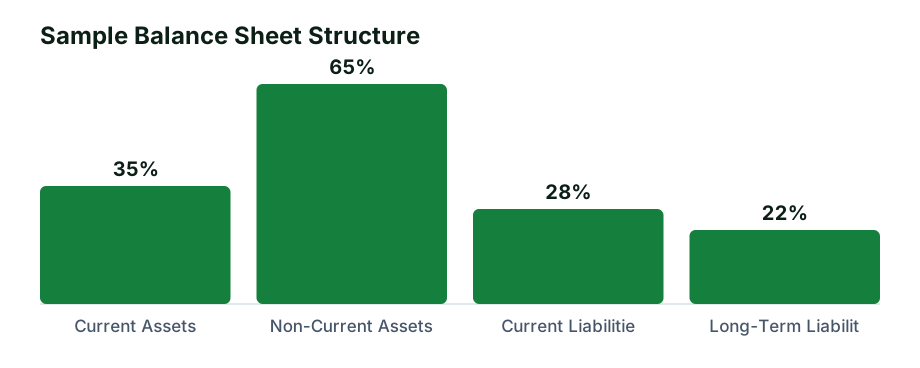
Every balance sheet has three sections. Understanding what belongs in each is the foundation of balance sheet analysis for stocks.
Assets
Assets are everything the company owns or controls that has economic value. They are split into two types:
Current Assets (can be converted to cash within 12 months):
- Cash and bank balances
- Marketable securities
- Accounts receivable (money customers owe)
- Inventory
- Prepaid expenses
Non-Current Assets (held longer than 12 months):
- Property, plant, and equipment (factories, machinery)
- Intangible assets (patents, goodwill, brand value)
- Long-term investments
- Deferred tax assets
Liabilities
Liabilities are obligations the company must pay. They are also split into two types:
Current Liabilities (due within 12 months):
- Accounts payable (money owed to suppliers)
- Short-term borrowings
- Dividend payable
- Current portion of long-term debt
Non-Current Liabilities (due after 12 months):
- Long-term debt (bonds, bank loans)
- Deferred tax liabilities
- Long-term provisions (employee retirement benefits)
Shareholder Equity
Shareholder equity (also called net worth) is what remains after subtracting all liabilities from all assets. It represents the owners' stake in the company. It includes:
- Share capital (money raised by issuing shares)
- Reserves and surplus (retained profits, revaluation reserves)
- Other comprehensive income
How to Read the Assets Section (Current vs Non-Current)
The balance sheet lists assets in order of liquidity—most liquid first. Here's how to interpret what you see.
Current Assets: The Company's Short-Term Firepower
Look at the ratio of current assets to current liabilities. If a company has ₹100 crore in current assets but ₹80 crore in current liabilities due within 12 months, it has a cushion. If the reverse is true, it may struggle to pay bills.
Example: Suppose you're analyzing TechCorp Ltd., an IT services company. Its balance sheet shows:
-
Cash: ₹50 crore
-
Receivables: ₹120 crore
-
Inventory: ₹10 crore
-
Total Current Assets: ₹180 crore
-
Payables: ₹60 crore
-
Short-term debt: ₹30 crore
-
Total Current Liabilities: ₹90 crore
The current ratio for liquidity is 180 ÷ 90 = 2.0, meaning the company has ₹2 of current assets for every ₹1 of current liability. This is healthy for most sectors.
Non-Current Assets: Long-Term Strength
Non-current assets show whether the company is investing in growth (factories, equipment) or has accumulated intangible assets (goodwill from acquisitions). A manufacturing company should have substantial property, plant, and equipment. A software company may have lower tangible assets but higher intangible value.
Watch for inflated goodwill. If a company acquired another business and recorded ₹500 crore in goodwill but the acquired company is underperforming, that goodwill may be written down later, hurting shareholder value.
Understanding Liabilities: Short-Term and Long-Term Debt
Debt is not inherently bad—companies use it to finance operations and growth. But excessive debt, especially short-term debt, signals risk.
Current Liabilities: The Immediate Pressure
High current liabilities relative to current assets mean the company is under pressure to generate cash quickly. If a company has ₹100 crore in current liabilities but only ₹60 crore in current assets, it may need to borrow more or sell assets to stay afloat.
Long-Term Debt: The Leverage Story
Long-term debt tells you how much the company has borrowed for long-term needs. Compare it to equity. A company with ₹500 crore in equity and ₹100 crore in long-term debt is moderately leveraged. One with ₹500 crore in debt and ₹100 crore in equity is highly leveraged and risky.
The debt-to-equity ratio is the standard metric: Total Debt ÷ Shareholder Equity. A ratio under 1.0 is generally safe; above 2.0 is concerning for most sectors.
Interest Coverage: Can the Company Pay Its Debt?
This isn't on the balance sheet, but it's derived from it. Take the company's operating profit (from the P&L) and divide by interest expense (from the P&L). If the ratio is less than 2.0, the company is struggling to cover interest payments from operations—a red flag.
Shareholder Equity and What It Reveals About Ownership
Shareholder equity is the book value of the company. Divide total equity by the number of outstanding shares to get book value per share.
If a company has ₹1,000 crore in equity and 100 crore shares outstanding, the book value per share is ₹10. If the stock trades at ₹50, the price-to-book ratio is 5.0—meaning investors are paying ₹5 for every ₹1 of book value. For a stable, mature company, this might be reasonable. For a slow-growing company, it could signal overvaluation.
Watch for declining equity. If equity shrinks year-over-year, the company is either losing money or paying out more in dividends than it earns. Sustained decline is a warning sign.
Also check reserves and surplus. This is retained earnings—profit the company didn't distribute as dividends. Growing reserves show the company is reinvesting profits into the business.
Key Balance Sheet Ratios Every Investor Should Track
| Ratio | Formula | What It Means | Healthy Range |
|---|---|---|---|
| Current Ratio | Current Assets ÷ Current Liabilities | Ability to pay short-term obligations | 1.5 to 3.0 |
| Quick Ratio | (Current Assets – Inventory) ÷ Current Liabilities | Liquidity without relying on inventory sales | 1.0 to 2.0 |
| Debt-to-Equity | Total Debt ÷ Shareholder Equity | Financial leverage | Under 1.0 |
| Return on Equity (ROE) | Net Profit ÷ Shareholder Equity | Profit generated per rupee of equity | Above 15% |
| Asset Turnover | Revenue ÷ Total Assets | Efficiency in using assets | Varies by sector |
Track these ratios over three to five years. A company with improving ratios is strengthening; one with deteriorating ratios is weakening.
Red Flags in Balance Sheet Analysis
High Debt with Weak Profits
If total debt is growing but operating profit is flat or declining, the company is borrowing to survive, not to invest. This is unsustainable.
Declining Cash Balances
Year-over-year drops in cash (without corresponding investments in growth) suggest the company is burning money. Check why in the cash flow statement.
Inventory Buildup
If inventory is growing faster than revenue, the company may be struggling to sell products. This ties up cash and risks write-downs if products become obsolete.
Related-Party Transactions
Check the notes to the balance sheet for large transactions between the company and related parties (promoters, group companies). These can hide value transfer or poor governance.
Promoter Pledging Risks
In the notes, look for disclosures about pledged shares. If the promoter has pledged a large percentage of their holding to secure loans, it signals financial stress. If the stock price falls, the lender may sell those shares, crashing the price further.
Sudden Changes in Accounting Policies
The notes section discloses changes in accounting methods. Changes in depreciation rates, asset valuation, or provision policies can inflate or deflate reported equity and profit. Investigate why.
How to Compare Balance Sheets Across Two Companies
Comparing raw numbers is meaningless—a ₹10,000 crore company will have larger assets than a ₹1,000 crore company. Instead, compare ratios and trends.
Step 1: Standardize the Comparison
Use ratios, not absolute numbers. Compare current ratios, debt-to-equity, and ROE side by side.
Step 2: Look at Trends, Not Snapshots
Pull balance sheets from the last three years for each company. Is equity growing? Is debt stable or climbing? Trends reveal trajectory.
Step 3: Use Sector Benchmarks
A bank's balance sheet looks radically different from a retailer's. Banks are expected to have high leverage; retailers are not. Compare each company to its sector peers, not to companies in unrelated industries.
Step 4: Check the Quality of Earnings
A company with high equity might have inflated it through one-time gains or revaluation of assets. Check the P&L and cash flow statement to confirm that equity growth is driven by sustainable profit, not accounting adjustments.
Example: Comparing Two Pharma Companies
| Metric | PharmaA | PharmaB | Analysis |
|---|---|---|---|
| Current Ratio | 2.1 | 1.3 | PharmaA has better short-term liquidity |
| Debt-to-Equity | 0.4 | 0.8 | PharmaA is less leveraged; lower financial risk |
| ROE (3-year avg) | 18% | 22% | PharmaB generates more profit per rupee of equity |
| Equity Growth (3-year CAGR) | 12% | 8% | PharmaA's equity is growing faster |
PharmaA looks financially safer; PharmaB is more profitable but riskier. Your choice depends on your risk tolerance and investment horizon.
Frequently asked questions
Q: What is the most important thing to look for in a balance sheet?
Check the debt-to-equity ratio and current ratio for liquidity first. A high debt load or weak liquidity (low current assets vs liabilities) signals financial stress. A company can survive one bad quarter; it cannot survive insolvency.
Q: How often should I review a company's balance sheet?
Review quarterly (after Q1, Q2, Q3 results) and annually after FY 2026-27 results are published. Major changes can indicate shifts in financial health. Set a reminder to check balance sheets when your portfolio companies announce results.
Q: Can I compare balance sheets of two companies in different sectors?
You can compare structure and trends, but use sector-specific benchmarks. A bank's balance sheet looks very different from a tech company's—context matters. Banks are expected to have high leverage; tech companies are not. Always compare within sector first.
Q: Where do I find a company's balance sheet online?
Check the NSE/BSE website, the company's investor relations page, or financial sites like MoneyControl. Annual reports contain audited balance sheets. Quarterly results also include unaudited balance sheets. For investing basics, start with the company's official website.