
If you have ever wondered how to read current ratio in Indian stocks without relying on the textbook 2:1 rule, this guide breaks it down with real NSE/BSE context. You will learn the formula, sector-specific benchmarks, where to find the data, and why an abnormally high ratio can actually signal inefficient capital deployment rather than financial strength.
What Is Current Ratio in Stock Analysis?
The current ratio is a liquidity metric that compares a company's current assets to its current liabilities. In the Indian context, it answers a simple but critical question: if an NSE or BSE listed company had to settle all its short-term obligations tomorrow, would it survive using assets it can convert to cash within the next 12 months?
Current assets typically include cash and bank balances, trade receivables, short-term investments, inventories, and prepaid expenses. Current liabilities include trade payables, short-term borrowings, the current portion of long-term debt, and accrued expenses.
For Indian retail investors, this ratio sits alongside other solvency ratios as a foundational check before committing capital. A company can be profitable on its income statement and still collapse if it runs out of liquid resources to pay suppliers, banks, or employees on time.
As part of broader investing basics, the current ratio helps you separate companies with genuine working capital discipline from those running on stretched payables or bloated inventory that may never convert to cash.
Current Ratio Formula with a Worked Example
The formula is straightforward:
Current Ratio = Current Assets ÷ Current Liabilities
Let us walk through a realistic example using an Indian FMCG company. Assume the following figures from the balance sheet for FY 2026-27:
-
Current Assets
- Cash and bank balances: ₹1,200 crore
- Trade receivables: ₹850 crore
- Inventories: ₹1,400 crore
- Short-term investments: ₹300 crore
- Prepaid expenses and other current assets: ₹250 crore
- Total current assets: ₹4,000 crore
-
Current Liabilities
- Trade payables: ₹900 crore
- Short-term borrowings: ₹600 crore
- Current portion of long-term debt: ₹200 crore
- Statutory payables and other current liabilities: ₹300 crore
- Total current liabilities: ₹2,000 crore
Current Ratio = ₹4,000 crore ÷ ₹2,000 crore = 2.0
A ratio of 2.0 means the company has ₹2 of current assets for every ₹1 of current liabilities. By the traditional textbook standard, this is considered safe. But as you will see in the next section, blindly applying this benchmark across all Indian stocks can mislead you.
What Is a Good Current Ratio for Indian Stocks?
The old rule of thumb says a current ratio of 2:1 is ideal, and anything under 1:1 signals danger. In the Indian market, this rule oversimplifies reality.
Here is a more practical way to read the ratio for NSE and BSE listed companies:
- Below 1.0: The company has more short-term obligations than liquid assets. This is a red flag unless the business model naturally operates with negative working capital — for example, telecom companies or retail chains that collect cash upfront and pay suppliers late.
- Between 1.0 and 1.5: Generally adequate for sectors with fast inventory turnover and predictable receivables, such as FMCG or IT services. It may be tight for capital-intensive sectors.
- Between 1.5 and 2.5: Considered healthy for most Indian non-financial companies. There is enough buffer to absorb shocks without tying up excessive capital.
- Above 3.0: This is where caution sets in. A very high ratio can mean the company is sitting on idle cash, carrying slow-moving inventory, or failing to collect receivables on time. None of these are signs of operational efficiency.
A current ratio above 3.0 in an Indian manufacturing company often points to inventory buildup or receivables stuck with customers. That capital is technically liquid on paper but practically unavailable. Check whether the high ratio is driven by cash — which is genuinely liquid — or by inventory and receivables, which carry conversion risk.
Sector-Wise Current Ratio Benchmarks in India
Different sectors in India operate with structurally different working capital models. Applying a single benchmark across all of them is a mistake. Below is a practical reference table based on typical ranges observed in NSE and BSE listed companies.
| Sector | Typical Current Ratio | Reason |
|---|---|---|
| FMCG (Hindustan Unilever, Nestle India, Britannia) | 1.2 to 1.8 | Fast inventory turnover, strong bargaining power with suppliers |
| IT Services (TCS, Infosys, Wipro) | 1.8 to 3.0 | Large cash buffers, minimal inventory, receivables mostly from blue-chip clients |
| Auto and Auto Ancillaries (Maruti Suzuki, Bosch, Bharat Forge) | 1.0 to 1.8 | Inventory-heavy operations, dealer network receivables |
| Steel and Metals (Tata Steel, JSW Steel, Hindalco) | 1.0 to 1.5 | High working capital intensity, cyclical demand |
| Pharmaceuticals (Sun Pharma, Cipla, Dr Reddy's) | 1.5 to 2.5 | Export receivables, regulatory approval cycles, inventory of APIs and formulations |
| Infrastructure and Construction (L&T, IRB, NCC) | 1.0 to 1.5 | Long project cycles, receivables from government and private clients |
| Retail (Avenue Supermarts, Trent) | 0.8 to 1.2 | Negative or low working capital due to cash sales and supplier credit |
| Power Utilities (NTPC, Power Grid) | 0.8 to 1.2 | Regulated receivables, government payment cycles |
Why IT Companies Run Higher Ratios
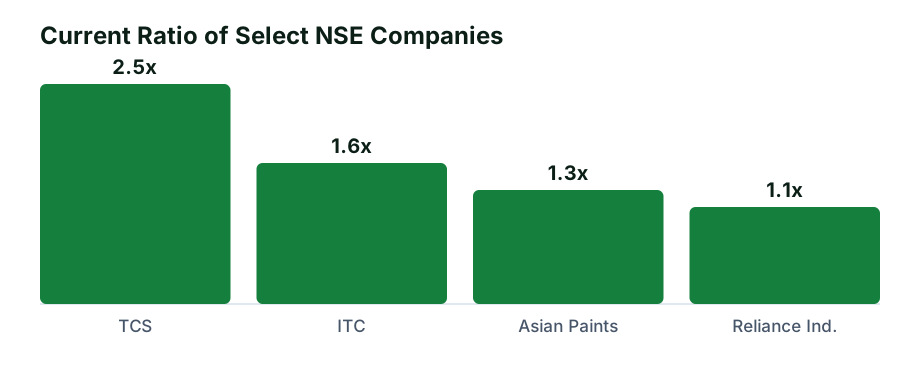
IT services companies in India typically hold large cash reserves because their business is asset-light and they generate steady cash flow from international contracts. A current ratio of 2.5 in TCS or Infosys is not unusual and does not signal inefficiency. The cash is often used for dividends, buybacks, or acquisitions.
Why Retailers Run Lower Ratios
Avenue Supermarts (DMart) often operates with a current ratio close to or under 1.0. This is not a distress signal — it reflects the company's ability to sell inventory before paying suppliers. Negative working capital is a competitive advantage in retail, not a weakness.
Current Ratio vs Quick Ratio — Key Differences
The current ratio includes all current assets, but not all current assets are equally liquid. Inventory can take months to sell. Prepaid expenses never convert back to cash. This is where the quick ratio, also called the acid-test ratio, becomes useful.
Quick Ratio = (Current Assets − Inventory − Prepaid Expenses) ÷ Current Liabilities
The key differences between the two ratios:
- Inventory treatment: Current ratio includes inventory; quick ratio excludes it. For Indian companies with large inventory exposure — such as auto ancillaries or steel producers — the quick ratio gives a stricter read on liquidity.
- Conservatism: The quick ratio is the more conservative measure. A company with a current ratio of 2.0 but a quick ratio of 0.8 may look safe on paper but could struggle if inventory cannot be sold quickly.
- Sector relevance: For IT and services companies with negligible inventory, both ratios tend to be similar. For manufacturing and retail, the gap between them matters.
- Interpretation for Indian stocks: A quick ratio above 1.0 is generally considered safe. Below 0.5 is a warning sign unless the company has predictable, fast cash conversion.
Using both ratios together gives you a fuller picture. If the current ratio is healthy but the quick ratio is weak, dig into the inventory composition and receivables aging before concluding the company is financially sound.
How to Find Current Ratio of Any NSE or BSE Company
You do not need to calculate the current ratio manually every time. Here are the most reliable sources for Indian listed companies:
- Annual Report: The balance sheet in the annual report is the primary source. Look at the "Current Assets" and "Current Liabilities" sections. Most annual reports also show comparison figures for the previous year.
- NSE Website: Visit the NSE company page, navigate to the "Financials" tab, and check the balance sheet data. The NSE provides quarterly and annual financials for all listed companies.
- BSE Website: Similar to NSE, the BSE company page under the "Financials" section provides balance sheet details.
- Screener.in: One of the most popular tools among Indian retail investors. Screener shows the current ratio, quick ratio, and a 10-year history in a single line for each company.
- Trendlyne: Provides ratio analysis with visual charts, sector comparisons, and alerts when ratios cross certain thresholds.
- Company Investor Presentations: Many large-cap companies include liquidity ratios in their quarterly investor presentations, saving you the effort of manual calculation.
For companies with complex balance sheets — such as conglomerates with multiple subsidiaries — cross-check the consolidated balance sheet rather than the standalone one. The consolidated view captures the true liquidity position of the entire group.
Red Flags: When Current Ratio Misleads Investors
The current ratio is a snapshot, not a verdict. Several situations can make the ratio look healthy when the underlying reality is different.
Inventory That Will Not Convert
A steel company sitting on slow-moving inventory may show a current ratio of 2.0, but if that inventory consists of products with no immediate buyer, the real liquidity is much lower. Always cross-reference inventory turnover ratios and check management commentary on inventory days.
Receivables Stuck With Weak Customers
Trade receivables are counted as current assets, but if a company's customers are themselves in financial distress, those receivables may take far longer than 90 days to collect. In extreme cases, they turn into bad debts. This is particularly relevant for Indian infrastructure and construction companies where government and state-owned enterprise dues can stretch for months.
Window Dressing Before Quarter End
Some companies temporarily pay down short-term debt or delay recognizing payables just before the quarter ends to present a stronger balance sheet. Compare the current ratio across multiple quarters rather than relying on a single data point.
High Ratio From Idle Cash
A current ratio of 4.0 driven by a massive cash pile might look safe, but if that cash is not being deployed into growth, dividends, or buybacks, it drags down return on equity. Investors should question why management is sitting on cash rather than putting it to productive use.
Ignoring Promoter Pledging
A healthy current ratio does not protect you if the promoters themselves have pledged a large portion of their shareholding. Promoter pledging is a separate risk that can trigger forced selling and stock price collapse, regardless of the company's operational liquidity.
Using Current Ratio Alongside Other Solvency Metrics
No single ratio tells the full story. The current ratio answers the liquidity question, but you need to pair it with other metrics to assess overall financial health.
- Debt-to-Equity Ratio: A company with a healthy current ratio but a debt-to-equity ratio above 2.0 may still be at risk if interest costs rise. Check solvency ratios alongside liquidity.
- Interest Coverage Ratio: Profitability relative to interest payments determines whether the company can service its debt. A strong current ratio means little if operating profits cannot cover interest costs. Use the interest coverage ratio as a complementary check.
- Inventory Turnover Ratio: Tells you how quickly inventory converts to sales. Low turnover combined with a high current ratio signals inventory risk.
- Receivables Days: Shows how long it takes to collect money from customers. Rising receivables days alongside a stable or rising current ratio is a warning that the quality of current assets is deteriorating.
- Operating Cash Flow: A company can show a strong current ratio but negative operating cash flow if profits are not converting to cash. Check the cash flow statement for the same period.
The most effective approach is to read the current ratio as one layer in a multi-step financial check. Start with liquidity, move to solvency, then assess profitability and cash flow quality. Only then can you form a reliable view of whether an NSE or BSE listed company is fundamentally sound.
Frequently asked questions
What is the ideal current ratio for Indian stocks?
A current ratio between 1.5 and 2.0 is generally considered healthy for most Indian non-financial companies, though the ideal range varies by sector and business model.
Is a very high current ratio always good?
No. A current ratio above 3.0 may indicate that a company is holding too much idle cash or inventory instead of deploying capital productively, which can drag on returns.
How is current ratio different from quick ratio?
The quick ratio excludes inventory from current assets, giving a stricter measure of liquidity. Current ratio includes all current assets, making it broader but less conservative.
Where can I find the current ratio of an NSE-listed company?
You can find it on the company's balance sheet in its annual report, on the NSE website under company financials, or on financial data portals like Screener and Trendlyne.
Is current ratio relevant for banking stocks?
Current ratio is not meaningful for banks and NBFCs because their business model does not separate current assets and current liabilities the way manufacturing or services companies do.