Return on equity is one of the cleanest ways to judge whether an Indian company is actually generating profits from the money shareholders have put in—not just growing sales or expanding assets. This guide on return on equity Indian stocks breaks down the formula, shows you exactly where to find the numbers in an annual report, and benchmarks what counts as "good" against Nifty 50 averages rather than vague global rules of thumb.
What Is Return on Equity (ROE) for Indian Stocks
ROE tells you how much profit a company generates for every rupee of shareholders' equity it holds. If a company has ₹100 crore of equity and reports ₹20 crore of net profit, its ROE is 20%—meaning shareholders earned 20 paise for every rupee of equity deployed.
ROE matters because it strips away the noise of revenue growth and focuses on a single question: is the business converting owner's capital into profit efficiently? A company can double its sales by taking on debt or issuing new shares, but if net profit isn't growing proportionally, ROE will expose the gap.
For Indian retail investors analyzing NSE and BSE listed companies, ROE is especially useful because it works across sectors—you can compare an IT services firm against an FMCG manufacturer without needing to adjust for business model differences. The metric is also a key input in frameworks like DuPont analysis and is one of the factors index providers consider when constructing quality indices.
The ROE Formula and How to Calculate It
The basic ROE formula is:
ROE = (Net Profit / Shareholders' Equity) × 100
Two inputs, both pulled from the annual report.
Net Profit
Use profit after tax (PAT) for the full financial year, not quarterly numbers. For FY 2026-27, you would take the PAT figure reported in the audited annual report. If you are calculating ROE mid-year using trailing twelve months (TTM) data, sum the last four quarters of PAT—but be aware TTM ROE won't match the audited full-year figure exactly.
Shareholders' Equity
This is the sum of:
- Paid-up share capital (equity capital at face value of a share)
- Reserves and surplus (retained earnings, securities premium, general reserve)
- Money received against share warrants (if any)
Some analysts subtract minority interest and preference shares to get "equity attributable to parent shareholders." For most NSE/BSE large-caps, the difference is small, but it matters for conglomerates with subsidiaries.
Worked Example
Say a company reports:
- Net profit (PAT): ₹4,500 crore
- Paid-up share capital: ₹500 crore
- Reserves and surplus: ₹19,500 crore
Shareholders' equity = ₹500 + ₹19,500 = ₹20,000 crore ROE = (4,500 / 20,000) × 100 = 22.5%
That's a strong number for most sectors, though context matters—we'll get to benchmarks shortly.
Where to Find ROE Inputs in an Indian Annual Report
Indian annual reports follow a standard structure mandated by the Companies Act and Ind AS. Here's exactly where to look.
Net Profit — Profit and Loss Statement
Open the annual report and navigate to the "Statement of Profit and Loss" (sometimes called "Income Statement"). Scroll to the bottom. The line you want is:
- "Profit for the year" (Ind AS terminology) — this is PAT after tax and all expenses.
Avoid using "Profit before tax" or "Operating profit"—ROE uses the bottom-line net profit.
Shareholders' Equity — Balance Sheet
Go to the "Balance Sheet" section. Under the "Equities and Liabilities" side, look for:
- Shareholders' Funds — this is your header
- Within it: "Share capital" (paid-up)
- And: "Reserves and surplus"
Add these two. That's your equity number.
Some annual reports also show "Total equity attributable to owners of the parent" as a single line—use that if available, it's the same thing.
Quick Shortcut — Screener and Tickertape
If you don't want to open a 300-page PDF, aggregators like Screener.in and Tickertape pull these figures directly from BSE/NSE filings. They display ROE pre-calculated. But it's worth doing the manual calculation once or twice to understand what goes into the number—aggregators sometimes use TTM figures and can differ from annual report numbers by 1-2 percentage points.
What Is a Good ROE for Indian Companies
This is where most global guides go wrong. The often-quoted "ROE above 15% is good" rule comes from US large-caps and doesn't map cleanly to Indian sectors where capital structures and business models differ.
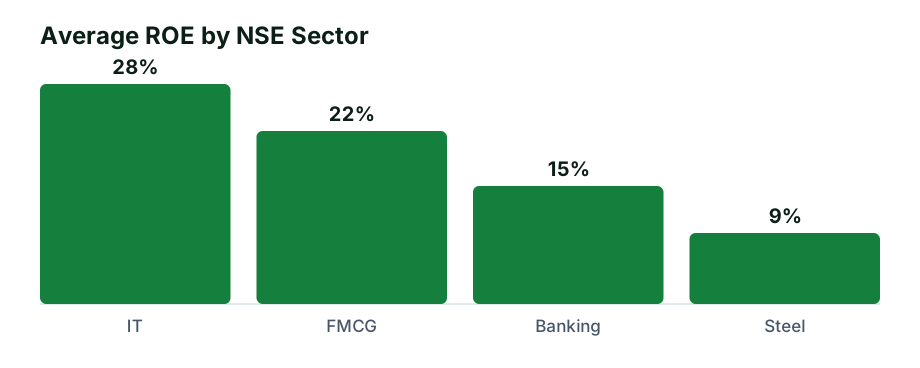
Here's a more useful framework based on typical ranges observed across NSE/BSE listed companies:
| Sector | Typical ROE Range | Notes |
|---|---|---|
| IT services (TCS, Infosys, HCL Tech) | 25–40% | Asset-light, high margins, low debt |
| FMCG (HUL, Nestle, Britannia) | 40–80% and above | Very low equity base due to large reserves |
| Private banks (HDFC Bank, ICICI) | 15–18% | Regulated capital requirements cap ROE |
| Pharma (Sun, Cipla, Dr Reddy's) | 12–20% | Varies by R&D intensity and US exposure |
| Auto (Maruti, M&M, Tata Motors) | 10–18% | Cyclical, capital-intensive |
| Steel and metals (Tata Steel, JSW) | 8–15% | High capex, commodity-driven |
| Power and utilities (NTPC, Power Grid) | 10–14% | Regulated returns, asset-heavy |
| PSUs (ONGC, IOC, Coal India) | 10–15% | Government dividend pressures |
A few takeaways from this table:
- FMCG companies often show ROE above 40%—but this is partly because decades of retained earnings have swollen reserves while paid-up capital stays tiny. A 60% ROE at HUL doesn't mean the business is "four times better" than HDFC Bank at 17%.
- Banks are structurally capped because RBI mandates minimum capital adequacy ratios. A bank with 25% ROE is probably taking excess risk.
- Capital-intensive sectors like steel and power will rarely cross 15% ROE in normal years. Comparing Tata Steel to Infosys on ROE alone is misleading.
A practical rule: compare a company's ROE against its sector average, not against a universal benchmark. If you're analyzing a pharma company, 16% ROE is solid. If you're looking at an IT services firm, 16% is mediocre.
Why High ROE Should Be Cross-Checked with Debt
ROE has a built-in trap. Because equity is the denominator, anything that shrinks equity inflates ROE—even if the business hasn't improved.
The most common way equity shrinks is debt. When a company funds operations through borrowing instead of equity, the equity base stays small while assets grow. If profits rise, ROE looks spectacular. But the company has taken on financial risk.
This is why you should always read ROE alongside the debt to equity ratio in Indian stocks. A company with 30% ROE and debt-to-equity of 0.2 is genuinely efficient. A company with 30% ROE and debt-to-equity of 3.0 is leveraged—and a single bad year can wipe out equity through interest costs.
Also check the interest coverage ratio to confirm the company can comfortably service its debt from operating profits. High ROE with weak interest coverage is a warning sign, not a green light.
For promoter-led companies, watch for promoter pledging as well. Promoters who pledge shares to raise personal debt often do so because the company is highly leveraged or needs capital—both of which can distort the ROE picture.
Nifty 50 Average ROE Benchmark for FY 2026-27
For FY 2026-27, the Nifty 50's aggregate return on equity sits in the range of 14–16%, based on trailing earnings and current book values of index constituents. This is a useful baseline: if you're evaluating a large-cap Indian stock, beating the Nifty 50 average ROE is a reasonable threshold for "above-average capital efficiency."
However, the index average is weighted heavily by financials (HDFC Bank, ICICI Bank, SBI together make up a large chunk) and IT (TCS, Infosys). These two sectors pull the average in opposite directions—banks drag it down due to capital requirements, IT lifts it up due to asset-light models.
A better approach for stock-picking:
- Calculate ROE for the company you're researching
- Compare it against 2–3 direct peers in the same sector
- Compare it against the Nifty 50 average as a sanity check
- Look at 5-year average ROE, not just one year—a single year can be distorted by one-off gains or losses
If a company consistently delivers ROE above both its sector peers and the Nifty 50 average for 5 or more years, that's a meaningful signal of durable competitive advantage. One year of high ROE proves nothing.
ROE vs ROCE — Which Metric to Use
ROE and ROCE (Return on Capital Employed) measure similar things but from different angles. The key difference is how they treat debt.
| Metric | Formula | What It Measures | Best For |
|---|---|---|---|
| ROE | Net Profit / Shareholders' Equity | Return to equity owners only | Low-debt companies, banks, FMCG |
| ROCE | EBIT / Capital Employed | Return on all capital (equity plus debt) | Capital-intensive sectors, leveraged firms |
Capital Employed = Total Assets minus Current Liabilities, or equivalently, Shareholders' Equity plus Long-term Debt.
When ROCE Is More Useful
- Comparing two companies in the same sector with different debt levels
- Evaluating capital-intensive businesses (steel, cement, power, telecom)
- Assessing whether a company earns more than its cost of debt (if ROCE is below the average interest rate on borrowings, the company is destroying value)
When ROE Is More Useful
- Comparing banks and financials (ROCE doesn't work well for banks because debt is their raw material)
- Looking at pure equity returns for retail shareholders
- Screening for quality using metrics like the DuPont decomposition
A company can have high ROE but low ROCE—this typically means it's using debt to boost equity returns. Conversely, a company with high ROCE but modest ROE is conservatively financed and may be under-leveraged.
For most Indian retail investors, looking at both metrics together is the right approach. If you're starting out, our investing basics guides cover how these fit into a broader fundamental analysis framework.
Red Flags: When ROE Is Inflated by Buybacks or Leverage
A high ROE number on its own doesn't tell you whether a business is good—it tells you profit is high relative to equity. Three situations can make ROE look impressive while the underlying business is weak or risky.
1. Large Buybacks
When a company buys back shares, it pays cash out of reserves. Reserves shrink, equity shrinks, and ROE rises—even if net profit is flat. Indian companies have been using buybacks more aggressively in recent years, especially IT firms (TCS, Infosys, Wipro have all done multi-thousand-crore buybacks). Check the 5-year trend of both net profit and equity separately. If equity is falling faster than profit is rising, the ROE improvement is mechanical, not operational.
2. High Financial Leverage
As discussed earlier, debt shrinks the equity base. A company with ₹1,000 crore of assets funded by ₹800 crore of debt and ₹200 crore of equity has a 5x leverage multiplier. If it earns ₹100 crore, ROE is 50%—but a 10% drop in asset value wipes out half the equity. Always read ROE with debt-to-equity and interest coverage.
3. One-Off Gains
If a company sells a subsidiary or land parcel and books a one-time gain, net profit spikes for that year. ROE spikes with it. Check whether the PAT figure you're using includes "exceptional items" or "other income" that won't recur. Most annual reports break this out—use "profit from continuing operations" if available.
4. Negative Equity
If accumulated losses exceed paid-up capital and reserves, shareholders' equity turns negative. ROE becomes mathematically meaningless (negative denominator). This happens with some distressed companies and is itself a red flag—don't try to interpret the ROE number, just avoid the stock.
Quick ROE Quality Checklist
- Is ROE above the sector average and Nifty 50 average for 5 or more years?
- Is debt-to-equity below 1 (or sector-appropriate)?
- Is interest coverage above 3–4x?
- Has equity grown in line with profits (no buyback-driven distortion)?
- Is PAT free of large one-off gains?
If all five check out, the ROE is likely a genuine signal of capital efficiency. If two or more fail, dig deeper before trusting the number.
Frequently asked questions
What is considered a good ROE for Indian stocks?
An ROE above 15% is generally considered good for Indian companies, but the benchmark varies by sector—IT and FMCG firms often exceed 25%, while capital-intensive sectors like steel and power may have lower ROE.
How is ROE different from ROCE?
ROE measures profit relative to shareholders' equity, while ROCE measures profit relative to total capital employed including debt—making ROCE better for comparing companies with different leverage levels.
Can a company have a high ROE because of high debt?
Yes. If a company takes on significant debt, its equity base shrinks relative to assets, inflating ROE. Always check ROE alongside the debt to equity ratio to confirm quality.
Where can I find net profit and equity figures for calculating ROE?
Both figures are available in a company's annual report—net profit is on the profit and loss statement, and shareholders' equity is on the balance sheet under 'Reserves and Surplus' plus paid-up capital.