If you have ever wondered why two companies with similar profits carry very different bankruptcy risk, the answer usually sits in one line of the profit and loss statement — interest expense. Learning how to read interest coverage ratio in Indian stocks tells you whether a company's operating profit can comfortably service its debt, and this guide walks you through the formula, where to find the numbers in an annual report, sector benchmarks, and how to pair the ratio with other risk checks.
What Is Interest Coverage Ratio in Indian Stocks?
The interest coverage ratio (ICR) measures how many times a company's operating profit can cover its interest payments for a given period. It is one of the cleanest short-term solvency checks in fundamental analysis because it focuses on cash-generating capacity relative to a fixed contractual obligation — interest on borrowings.
The basic idea is simple: EBIT divided by interest expense. A ratio of 4x means the company earns four rupees of operating profit for every one rupee of interest it owes. A ratio of 1x means operating profit barely covers interest. Anything below 1x means the company is not generating enough from operations to pay interest, and is funding the gap by drawing down cash, raising fresh debt, or selling assets.
For Indian listed companies, ICR matters because a large portion of corporate debt sits on the books of capital-intensive businesses — power, infrastructure, metals, telecom — where interest costs can swing sharply with rate cycles. The Reserve Bank of India's repo rate changes feed directly into floating-rate borrowing costs, so a company that looked safe at 3x coverage in a low-rate environment can slip to 2x or lower when rates harden.
How to Calculate Interest Coverage Ratio from Annual Reports
The interest coverage ratio formula for Indian companies is straightforward:
Interest Coverage Ratio = EBIT ÷ Interest Expense
Where:
- EBIT = Revenue from operations minus operating expenses (excluding interest and tax), also called Operating Profit
- Interest Expense = Finance costs as reported in the profit and loss statement
Let us walk through how to actually pull these numbers from an annual report filed with the NSE, BSE, and SEBI.
Step 1: Locate EBIT
Open the company's latest annual report. For most large caps with a March year-end, the FY 2025-26 financials are the most recent audited statements available in 2026, with FY 2026-27 results still a year away. Go to the Standalone or Consolidated Financial Statements — use Consolidated if the company has significant subsidiaries, because that is where the real debt sits.
In the Statement of Profit and Loss, look for:
- Revenue from operations
- Other income
- Total expenses (broken into cost of materials, employee benefits, depreciation, finance costs, and so on)
EBIT is not always reported as a single line under Ind AS. You typically compute it as:
EBIT = Profit before tax + Finance costs
Or equivalently:
EBIT = Revenue from operations + Other income − All operating expenses − Depreciation and amortization
Some analysts use EBITDA instead of EBIT to strip out depreciation, which gives a higher coverage number. That is acceptable for sectors with heavy depreciation (telecom, power), but the classic ICR uses EBIT.
Step 2: Locate Interest Expense
Under Ind AS, look for the line "Finance costs" in the profit and loss statement. This typically includes:
- Interest expense on borrowings
- Interest on lease liabilities (under Ind AS 116)
- Other finance costs
For a cleaner ICR, use only the borrowing-related interest, not lease interest. However, many screeners include total finance costs, which is why their numbers may differ slightly from your manual calculation.
Step 3: Divide
If a company reports EBIT of ₹2,400 crore and finance costs of ₹600 crore, ICR = 2,400 ÷ 600 = 4x. That is the EBIT to interest expense ratio Indian stocks investors rely on as a first-pass solvency check.
What Is a Good Interest Coverage Ratio for NSE and BSE Companies?
There is no universal "safe" number because the right threshold depends on the sector, the stability of cash flows, and the interest rate cycle. That said, for broad screening of NSE-listed companies, the following ranges are a useful starting point:
| ICR Range | Interpretation | Typical Sector Context |
|---|---|---|
| Above 5x | Very comfortable | FMCG, IT services, consumer durables |
| 3x to 5x | Safe | Most manufacturing, pharma, autos |
| 2x to 3x | Adequate but watch closely | Capital goods, chemicals, cement |
| 1x to 2x | Stretched | Power, infrastructure, metals (context-dependent) |
| Below 1x | Distressed | High default risk, avoid unless turnaround thesis |
For most non-cyclical businesses, an ICR above 3x is considered safe. For capital-intensive sectors with predictable revenues — regulated power utilities, for example — 2x may be acceptable because cash flows are contracted and stable.
A common mistake is to treat a high ICR as automatically good. A company with near-zero debt will show an extremely high ICR (or "not meaningful" if interest is nil), but that tells you nothing about return on equity or growth. It simply confirms there is no solvency risk from interest. Pair the reading with return ratios and capital allocation before drawing conclusions.
How Sector Differences Affect Interest Coverage Ratio
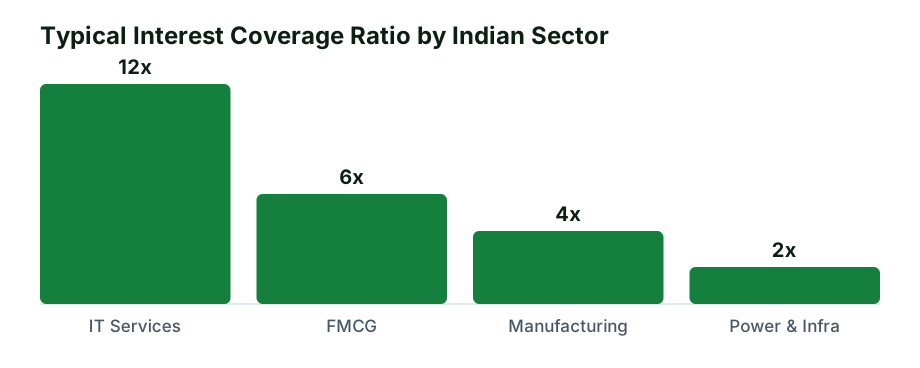
Interest coverage ratio interpretation for NSE stocks has to be sector-aware. Comparing Tata Power's ICR to Hindustan Unilever's ICR is not meaningful because their business models, capital structures, and depreciation profiles are completely different.
Capital-intensive sectors
Power, infrastructure, telecom, metals, and capital goods carry large debt on their balance sheets to fund long-gestation projects. Their ICR naturally sits lower. A telecom operator with ICR of 2x may be operating normally; an FMCG company at 2x would be a red flag.
Asset-light sectors
IT services, FMCG, diagnostics, and asset-light financial services typically run with little debt. Their ICR is often above 10x or not meaningful. A drop from 15x to 8x in an IT stock is not alarming — both are comfortable.
Cyclical sectors
Metals, chemicals, and commodities see ICR swing sharply with the cycle. A steel company at 5x during a price boom can fall to 1.5x in a downturn. Always look at the average ICR over a 5 to 10 year period, not just the latest year.
Financials (banks and NBFCs)
ICR does not apply to banks and NBFCs because interest is their raw material, not a financing cost. Use net interest margin, capital adequacy, and gross NPA instead.
Interest Coverage Ratio vs Debt to Equity Ratio
Both ratios measure leverage, but they answer different questions. The debt to equity ratio in Indian stocks tells you how the business is funded — the mix of debt versus equity. The interest coverage ratio tells you whether the business earns enough to service that debt.
A company can have high debt to equity and still be safe if its operating profit comfortably covers interest — this is common in regulated utilities with stable cash flows. Conversely, a company can have modest debt to equity but a weak ICR if its profits are depressed or if it carries high-cost short-term debt.
Use them together:
- High D/E + high ICR — leveraged but serviceable (acceptable for utilities, infrastructure)
- High D/E + low ICR — risky, avoid
- Low D/E + low ICR — small debt but profits under pressure, investigate the operating side
- Low D/E + high ICR — conservative balance sheet (typical of FMCG, IT)
Red Flags When Interest Coverage Ratio Falls Below 1
An ICR below 1 means EBIT is less than interest expense. The company is not generating enough operating profit to pay interest, and the shortfall must come from somewhere — cash reserves, fresh borrowings, asset sales, or equity dilution. This is a serious signal.
Specific red flags to watch:
- ICR below 1 for two consecutive years — one bad year can be explained by a cyclical trough; two years suggests structural trouble.
- Falling ICR alongside rising debt — profits shrinking while borrowings grow is the classic debt spiral.
- ICR below 1 combined with high promoter pledging — see promoter pledging in Indian stocks; promoters who have pledged shares face margin calls if the stock falls, which can trigger forced selling and further price declines.
- Interest expense growing faster than operating profit for three years — even if ICR stays above 1, a deteriorating trend signals tightening coverage.
- High working capital debt with short tenure — if the company is funding long-term assets with short-term working capital loans, rollover risk compounds the ICR problem.
When ICR is below 1, also check whether the company has refinanced debt, restructured loans under the RBI framework, or announced asset sales. These are signs management recognizes the stress. Without a credible deleveraging plan, a sub-1 ICR stock is a speculation, not an investment.
One technical note: a company with negative EBIT will show a negative ICR, which is worse than 1x. Screeners sometimes display this as "0" or "NA" — read the underlying numbers, not the screener output.
Where to Find Interest Coverage Ratio on Screener and Moneycontrol
You do not have to compute ICR manually every time. Indian financial platforms report it directly.
Screener.in
- Open the company page (for example, search "Tata Steel" on Screener).
- Scroll to the "Ratios" section.
- Look for "Interest Coverage Ratio" — it is reported for each of the last 10 years by default.
- To screen for ICR, use the query builder with a condition like
Interest coverage > 3combined with other filters such as market cap, ROE, or debt to equity.
Screener uses EBIT divided by interest expense, with finance costs pulled from the P&L. The numbers are reliable for most large and mid-caps but may lag for small-caps with delayed filings.
Moneycontrol
- Open the company's financials page.
- Go to "Ratios" under the Financials tab.
- Interest coverage ratio is listed alongside other solvency and profitability ratios.
- Moneycontrol also shows a 10-year trend, useful for spotting deterioration.
Tickertone and Trendlyne
Both platforms report ICR and let you filter stocks by ICR thresholds. Trendlyne's screeners are particularly useful for combining ICR with other fundamental filters.
Reading the annual report directly
For the most accurate figure, especially when screening results differ across platforms, go to the source. The company's annual report on the NSE or BSE website, or on its own investor relations page, contains the audited profit and loss statement from which you can compute ICR yourself.
Combining Interest Coverage Ratio with Other Risk Metrics
ICR is a single data point. Fundamental analysis interest coverage ratio work becomes meaningful only when you combine it with other checks to build a full risk picture.
A practical risk checklist
- Interest coverage ratio above 3x (or above 2x for capital-intensive sectors)
- Debt to equity under 1x for most sectors, under 2x for infrastructure and power
- Promoter pledging under 25 percent of promoter holdings — high pledging adds a separate layer of risk
- Positive operating cash flow for the last three years — profits can be managed, cash is harder to fake
- Interest expense growing slower than EBIT over a five-year window
- No qualified audit report on the financial statements
How the pieces fit together
Think of the balance sheet as a stack: the face value of a share is a nominal accounting entry that tells you nothing about solvency, but the real risk stack runs from debt levels (D/E) to debt servicing (ICR) to promoter skin in the game (pledging). A weakness in any one layer weakens the whole stack.
For example, a company with D/E of 0.8x, ICR of 4x, and zero promoter pledging is a low-risk balance sheet. A company with D/E of 1.5x, ICR of 1.8x, and 60 percent promoter pledging is high-risk even if the business is growing — because a stock price decline can trigger a margin call on pledged shares before operating performance catches up.
Sector-specific overlays
- FMCG and IT: ICR is usually high; focus more on return on equity and growth.
- Manufacturing: ICR and D/E both matter; track working capital days too.
- Infrastructure and power: ICR can be low but acceptable if cash flows are contracted; focus on project execution and refinancing risk.
- Metals and commodities: Look at ICR across the cycle, not at peak or trough.
For more depth on these checks, see more fundamental analysis guides on FinanceCity.
Frequently asked questions
What is a good interest coverage ratio for Indian stocks?
Generally, an interest coverage ratio above 3x is considered safe for most Indian companies, though capital-intensive sectors like power and infrastructure may operate comfortably at lower levels around 2x.
How is interest coverage ratio calculated?
Interest coverage ratio is calculated by dividing a company's EBIT (earnings before interest and taxes) by its interest expense for the same period, using figures from the profit and loss statement.
What does an interest coverage ratio below 1 mean?
A ratio below 1 means the company's operating profit is insufficient to cover its interest payments, indicating severe financial stress and a heightened risk of default.
Is interest coverage ratio the same as debt to equity ratio?
No, debt to equity ratio measures the proportion of debt versus equity used to fund the business, while interest coverage ratio measures whether operating profits can cover the interest on that debt.
Where can I find interest coverage ratio for NSE listed companies?
You can find the interest coverage ratio on financial screening platforms like Screener.in and Moneycontrol, or calculate it yourself from the interest expense and operating profit lines in the company's annual report.